
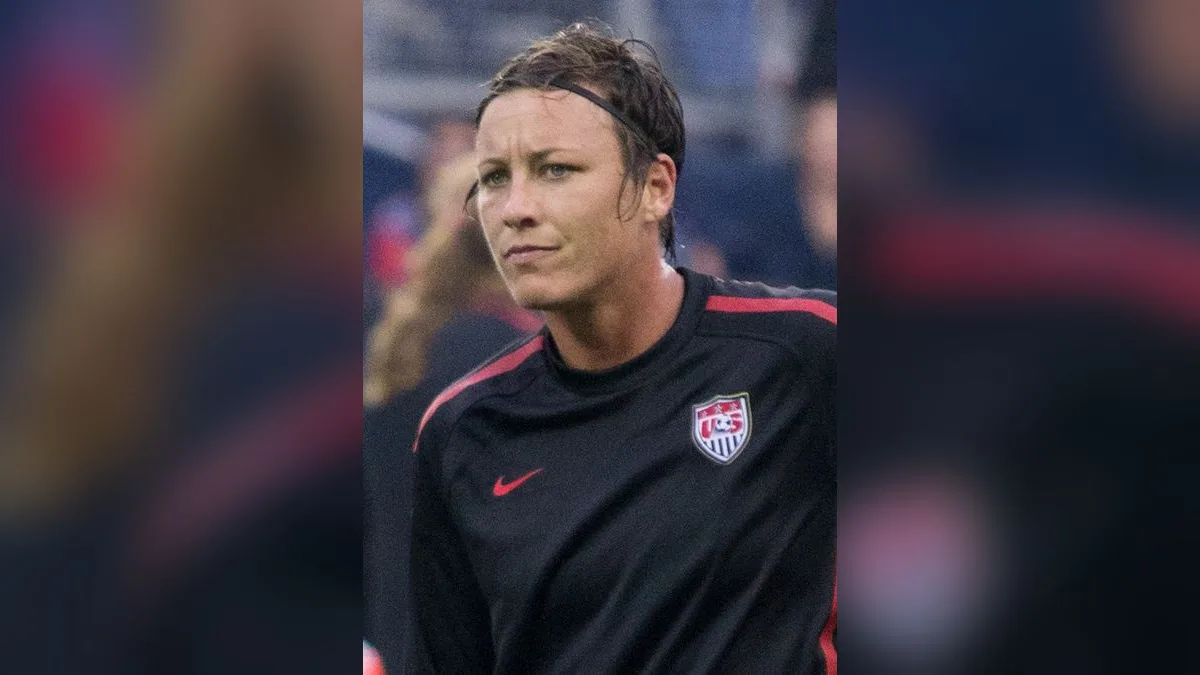
Abby Wambach made the penalty area her territory. The United States forward built a career on timing, courage, and relentlessness, rising above defenders to meet crosses and set the tone for a generation. Her goals stacked into a global record. Her presence changed how back lines defended and how teams thought about service, space, and set pieces. The numbers tell one story. The way matches bent around her tells another.
| Born | 2 June 1980 |
|---|---|
| Nationality | United States |
| Position | Forward |
| Height | 1.80 m |
| National team | United States (2001–2015) — 255 caps, 184 goals |
From Rochester roots to Florida breakthrough
Wambach grew up in the Rochester area in upstate New York, a multi-sport kid who discovered early that competing in the air could tilt a game. She took that edge to the University of Florida in the late 1990s, where she developed into a complete collegiate forward. Florida played on the front foot and asked its striker to battle, combine, and finish. Wambach answered with both power and craft. She left Gainesville with a national title during a period when the Gators rose fast and disrupted long-standing hierarchies in the women’s game.
The college years sharpened her anticipation and movement. They also gave her repetitions under pressure in front of sizable crowds and with serious expectations. By the time she turned professional, her habits were set: attack the ball, take hits, keep coming.
Club career across changing American leagues
Wambach’s professional path mirrored the turbulent early years of women’s club soccer in the United States. She entered the top flight with Washington Freedom in the first fully professional league. The Freedom won the championship in 2003, and Wambach became the team’s focal point in the box, a constant outlet for service and a defender’s worst assignment on set pieces.
When that league folded, she stayed ready through the stop-start cycle that followed. She returned to the Freedom in the next iteration of a domestic league and later featured in a short, stormy Florida stint that produced as many headlines off the field as on it. Through it all she scored, led, and kept standards. When the National Women’s Soccer League launched, she moved home to the Western New York Flash. That side pressed high, sent numbers forward, and trusted its forwards to finish. The Flash earned the league’s first regular-season title and reached the championship game, with Wambach central to their threat in the air and in hold-up play.
The club chapters show a through line: wherever Wambach played, the team’s identity tilted toward her strengths. Wide players served early. Midfielders looked for near-post runs and chipped balls to the back post. Centre backs stepped out with caution, mindful of fouls and free kicks around the box. Her presence shaped plans before a ball was kicked.
A record-shattering USWNT career
Wambach debuted for the United States in 2001 and grew into the most prolific scorer in international history, finishing with 184 goals. The total reflects more than volume. It tracks longevity, adaptation, and a knack for decisive moments. She scored across eras, alongside veterans she once idolised and youngsters she later mentored.
Major tournaments framed her legacy. She helped deliver Olympic gold in 2004 and again in 2012. A broken leg kept her out of the 2008 Games, a rare interruption in a career of availability. At World Cups she logged podium finishes, then lifted the trophy in 2015 to cap her international journey.
One image defines her on the global stage: a stoppage-time, back-post header against Brazil in 2011 to keep the United States alive. It was classic Wambach—timed run, fearless leap, clean contact—executed at the one moment her team could not afford a miss. That goal captured what opponents already knew. If a cross hung in the air and Wambach found a yard, danger followed.
In 2012 she was named FIFA World Player of the Year, recognition of peak form and sustained influence. It also marked how central she had become to the sport’s conversation, both at home and abroad.
What made Wambach different
Heading was the signature. Not just the power, but the mechanics: scanning before the cross, separating from markers late, and attacking the ball at its highest point. She used forearms and shoulders legally to hold position, then snapped her neck through contact to steer finishes into corners rather than simply thumping them on frame. Few forwards have ever controlled the air like that.
Her ground game mattered, too. Wambach’s first touch absorbed pressure and invited runners. She played simple layoffs that let wide players deliver in stride. In crowded boxes, she won second balls with strength and balance. She also drew fouls in dangerous areas, turning scrambles into set pieces her teams were built to exploit.
Above tactics and technique stood mentality. Wambach chased lost causes and demanded another cross when the last one failed. Late minutes felt like her minutes. Teammates fed off the certainty. Opponents felt the weight of it and sometimes retreated a step, which was all she needed.
Why her legacy endures
Wambach matters because she reframed what dominance could look like up top. In a sport that often celebrates the playmaker, she made the finisher a protagonist. Coaches at every level pointed to her heading as evidence that aerial craft is teachable and decisive. Youth players studied her runs and timing. Set-piece coaches designed routines with her patterns in mind.
She also carried the responsibilities that come with being the face of a team. Wambach embraced leadership, set hard standards within camps, and kept the program’s competitive edge during transitions between generations. As younger forwards emerged, she adjusted her role without surrendering the qualities that defined her. The final act—sharing a World Cup-winning roster spot while no longer starting every match—underlined a professional who understood both team arc and personal legacy.
Beyond the white lines, Wambach used her profile to push conversations about equality and inclusion forward. The details of advocacy evolve with time, but the stance was consistent: the platform is part of the job. For many fans and players, that combination—devastating in the box, direct about values—cemented her as a touchstone of the modern women’s game.
Abby Wambach’s record will always be the headline. The enduring memory is simpler: a cross arcing toward the far post and a No. 20 shirt arriving with conviction. Defenders jumped. Wambach rose higher.
Club career
| Years | Club | Apps | Goals |
|---|---|---|---|
| 2002–2004 | magicJack | — | — |
| 2002–2003 | Washington Freedom | 37 | 23 |
| 2009–2010 | Washington Freedom | 39 | 21 |
| 2011–2011 | magicJack | 11 | 9 |
| 2013–2014 | Western New York Flash | 29 | 17 |
| 2015–2015 | Seattle Reign FC | 0 | 0 |
Frequently asked questions
What made Abby Wambach’s playing style special?
She dominated aerially through timing, physicality, and precise heading technique—scanning, separating late, and snapping her neck to place headers rather than just power them. She combined that with a useful ground game: a composed first touch, effective layoffs, strength to win second balls, and an insistence on chasing every cross and opportunity.
Which clubs did Abby Wambach play for during her career?
Her professional path began with Washington Freedom in the first fully professional U.S. league, and she returned to the Freedom in the league that followed. Later she had a brief, eventful spell in Florida and finished back home with the Western New York Flash when the NWSL launched, where she was central to their attacking style.
What are Abby Wambach’s biggest achievements with the USWNT?
She retired as the most prolific scorer in international history with 184 goals and won Olympic gold twice. Major tournament highlights include a famous stoppage-time back-post header that kept the U.S. alive, a World Cup title to cap her international career, and being named FIFA World Player of the Year at the peak of her influence.
