
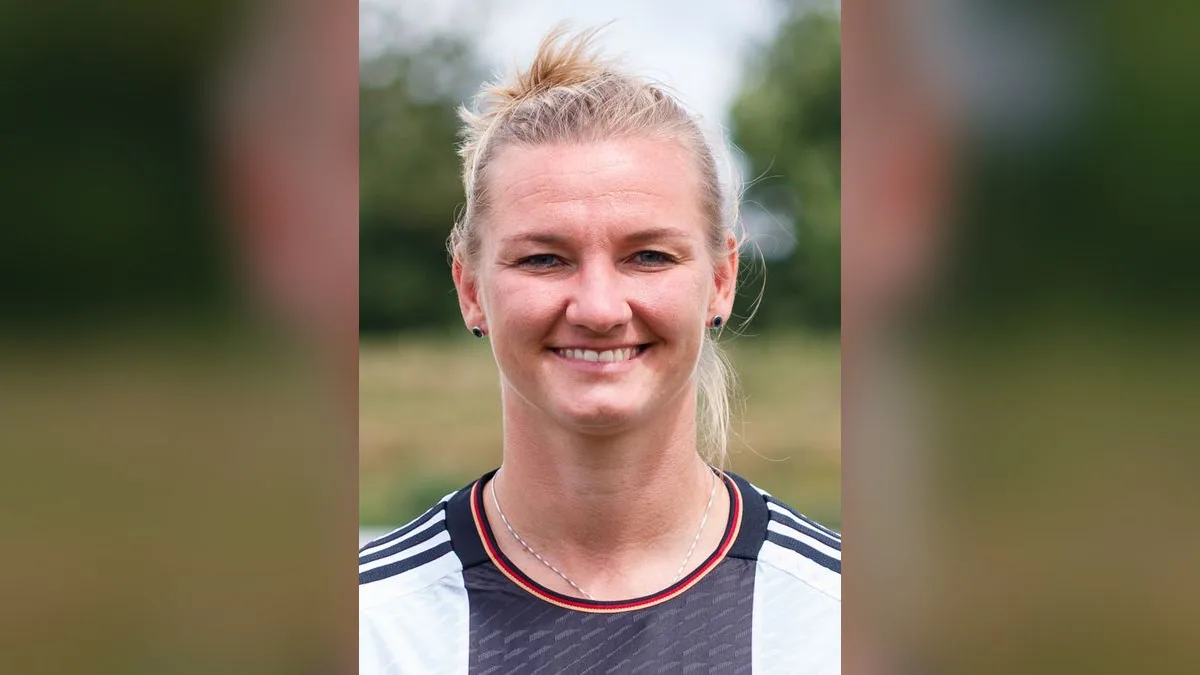
Alexandra Popp has spent her career combining physical power with an instinctive sense for the important moment. Her path traces a steady climb: a promising teenager who earned a senior break in the Ruhr, a move that shaped her game, and then a long spell at one of Europe’s established clubs where she matured into a leader for club and country. Popp is best known for her aerial strength, her ability to hold play up under pressure and the leadership she brings in big matches.
| Born | 6 April 1991 |
|---|---|
| Nationality | Germany |
| Position | Forward |
| Height | 1.74 m |
| National team | Germany (2010–2024) |
Early years and breakthrough at FCR 2001 Duisburg
Popp first entered senior football from the youth system and finished her apprenticeship at FCR 2001 Duisburg, where she spent the first four seasons of her professional career. Those years were formative. Duisburg offered Popp a regular place in a competitive environment and the chance to play in both domestic and continental matches at a young age. The club demanded a mix of technical quality and physical resilience, which suited Popp’s profile and accelerated her development.
At Duisburg she learned to compete aerially against some of the country’s better defenders and became a recognised threat on set pieces. The coaching set-up placed her in situations where she had to finish chances under pressure and to develop an all-round attacking game rather than rely on pure pace. That sharpening of technique and timing laid the groundwork for her later roles as a focal point in attack and a player opponents organised specifically to stop.
Move to VfL Wolfsburg and the step up
Joining VfL Wolfsburg in 2012 marked a clear step in Popp’s career. Wolfsburg’s expectations and resources provided a different environment: deeper squad competition, a higher baseline of tactical detail and more consistent exposure to matches that mattered. The move demanded more from her technically and mentally. She had to adapt to different strike partners and to systems that alternated between possession-first and direct attacking phases depending on the opponent.
At Wolfsburg Popp’s game broadened. Her role expanded beyond finishing to include leading the line, bringing team-mates into play and pressing from the front. The club environment also offered repeated high-pressure fixtures that tested rhythm and decision-making. Over time she became a reference point in attack whose presence altered how opponents defended and how Wolfsburg built from the final third.
International career: establishing herself with Germany
Popp’s introduction to senior international football followed her early club performances and she established herself as part of the national set-up from 2010 onwards. Her profile at international level has been consistent: a forward used for aerial dominance, set-piece threat and leadership in knockout matches. National coaches have relied on her in tournaments where physical duels and decisive headers often determine tight games.
She has also represented a continuity bridge between generations. As squad composition changed around her, Popp remained one of the players who could be trusted to perform in pressure moments. That reliability has been a major reason she continued to be selected and later to assume formal leadership roles within the team structure, where match temperament and example count as much as technical skill.
What she brings on the pitch
- Aerial authority: Popp is a dominant presence in the air and wins headers both in offensive and defensive phases.
- Hold-up play: She can receive under pressure, protect the ball and lay it off to advancing team-mates, creating space for others.
- Set-piece threat: Her timing on corners and free-kicks makes her a clear target when teams look for direct routes to goal.
- Work-rate and pressing: She contributes to the team’s defensive shaping by initiating the first line of press and forcing opponents into hurried passes.
- Leadership presence: Beyond tactics, her body language and commitment raise standards across match situations.
Those elements combine to make Popp more than a goalscorer. Teams set up to counter her aerial game, which opens space for teammates. She also offers tactical flexibility: coaches can ask her to play as a traditional centre forward, a focal point in a two-striker system, or to drop slightly deeper to connect play. That adaptability increases her value across different match plans.
Leadership and influence off the ball
Popp’s influence stretches into team culture. As she matured at club and national level she became a player who sets standards in training and calmness in matches. Leadership in women’s football often shows itself in small, accumulative ways: organising defensive transitions, setting pressing triggers, and acting as the go-to voice when games become tense. These qualities have made her a natural choice for captaincy and for other formal leadership roles.
On a tactical level her experience allows younger forwards to develop around her. She provides an example of movement, timing and how to occupy defenders without the ball. Where emerging talents bring pace or technical flair, Popp offers balance: an experienced forward who absorbs attention and brings structure. That mentoring role, while less visible than a goal, has long-term value for both club and country.
Why Alexandra Popp matters to the game
Popp matters because she exemplifies a model of forward play that remains rare: a player who marries aerial dominance with technical competence and leadership. In a period where the women’s game has diversified — with forwards now emerging in many different profiles — Popp is a reminder of the enduring value of a forward who can control the centre of attack and change the nature of an opponent’s defensive plan.
Her longevity at one of Germany’s top clubs and sustained presence in the national team show that she adapted as the game evolved. That adaptability, combined with moments of decisive impact, explains why coaches have structured teams around her. As a figure in German football she represents both the continuity of high-level domestic development and the professional standards expected at the top of the international game.
Looking at Popp’s career as a whole, the through-line is clear: steady technical improvement, greater tactical responsibility, and growing leadership. Those three elements define why she remains a central figure in German football and a forward other players are often measured against.
Frequently asked questions
What position does Alexandra Popp play?
Alexandra Popp plays as a forward. She is typically used as a central striker who contributes with aerial ability, hold-up play and set-piece threat.
When did Alexandra Popp join VfL Wolfsburg?
Alexandra Popp moved to VfL Wolfsburg in 2012. The transfer brought her into a more competitive club environment that expanded her tactical responsibilities and leadership role.
Has Alexandra Popp captained Germany?
Yes. Popp has served in leadership roles for the Germany women’s national football team and has been selected as captain at times, reflecting her experience and influence in major matches.
