
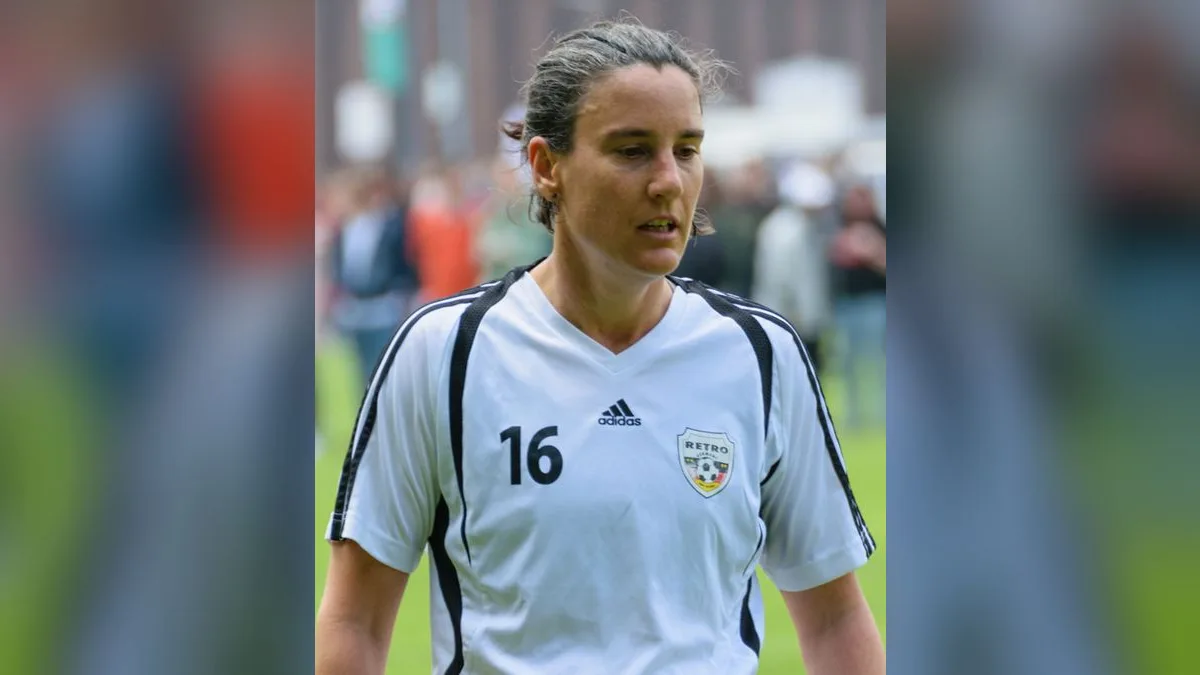
Birgit Prinz emerged as the clearest example of a modern centre-forward in women’s football. Built with rare athleticism and a striker’s instincts, she was the focal point of an exceptionally successful German national team and a dominant force at club level. Her career maps the growth of the women’s game in Germany and internationally: from domestic prominence to global recognition and enduring influence.
| Born | 25 October 1977 |
|---|---|
| Nationality | Germany |
| Position | Forward |
| Height | 1.79 m |
| National team | Germany (1994–2011) — 214 caps, 128 goals |
Early background and rise to the top
Prinz grew up in Germany and came through local youth football before stepping into top-level women’s football. Early domestic performances marked her out as a forward with an unusual blend of physical presence and technical skill. Her ability to hold the ball, bring teammates into play and finish chances made her immediately valuable to clubs and to national team coaches searching for a genuine number nine.
Her move into elite club football coincided with a period when the Frauen-Bundesliga and Europe’s top women’s clubs were professionalising. That environment suited Prinz’s strengths. She became a natural leader on the pitch, the sort of forward around whom teams built their attacking patterns. Her club form opened the door to regular international selection and to opportunities abroad, including a stint in the United States during the era of the WUSA.
Club career: dominance and continental success
Prinz’s club career is defined by sustained success at the highest level. She was a central figure for the leading German clubs of her generation, winning multiple domestic titles and continental trophies. At club level she combined a genuine goalscoring threat with the capacity to influence games beyond the box: dropping deep to link play, creating space for wide players and posing a continual aerial threat from set pieces.
Her time in the United States exposed her to a different style of play and provided valuable experience against international stars. Returning to Germany, she helped her clubs to further domestic dominance and to deep runs in European competition. Those seasons cemented her reputation as one of club football’s most reliable and dangerous forwards.
International career: leading Germany through a golden era
Prinz’s international career spanned more than a decade and coincided with perhaps the most successful period in Germany’s women’s national team history. She was central to Germany’s major tournament victories, including FIFA Women’s World Cup wins and multiple European Championship triumphs. Her presence altered how opposition teams set up defensively and how Germany structured attacks.
On the international stage she did more than score. Prinz often carried the load when games required a physical presence up front, could finish with both feet and was effective in the air. She alternated between being the main outlet for long balls and the technical focal point for crafted passing moves. That versatility made her hard to neutralise.
Playing style and footballing strengths
Prinz combined raw power with the technical tools to play an all-round forward’s game. Key elements of her play include:
- Physicality and hold-up play: Strong upper- and lower-body strength allowed her to shield the ball, retain possession under pressure and bring midfield runners into the game.
- Finishing variety: Effective with both feet and strong in the air, she posed a threat from inside the box and on set pieces.
- Movement and spatial awareness: Intelligent runs dragged defenders out of position and created space for teammates. She could play as a traditional target or as a mobile striker who created chances through movement.
- Work rate and tactical sense: Willingness to press, defend from the front and cover wide areas when needed made her a team player as well as a goalscorer.
These attributes made Prinz a prototype of the modern centre-forward: not just a finisher, but a player who shaped how a team attacked and defended. Her game aged well because it relied on more than pace; positional intelligence and technique meant she adapted as the sport evolved.
Legacy and why she matters
Prinz’s impact reaches beyond trophies and individual awards. She helped to raise the profile of women’s football in Germany and internationally at a time when the sport was gaining traction commercially and in the media. As a multiple-time FIFA World Player of the Year, her recognition brought attention to the quality of players emerging from Germany’s system and to the tactical sophistication of its teams.
On the pitch she provided a benchmark for centre-forwards who followed. Coaches and scouts used her as an example of how a striker could combine physical attributes with technical and tactical intelligence. Off the pitch, her visibility helped normalise the idea of elite women footballers as household sporting figures in Germany.
Prinz’s career is also a story of longevity and consistency at the very highest level. Sustained performance across club and country, adaptability to different leagues and the capacity to perform in tournament football are reasons she is remembered as one of the era’s defining players. Her influence is visible in the generation that came after: forwards who blend strength with skill and who are expected to contribute across every phase of play.
In the history of German women’s football, Birgit Prinz stands among the most important figures. Her combination of individual excellence and team success captures an era and helped set standards that continue to shape the women’s game.
Club career
| Years | Club | Apps | Goals |
|---|---|---|---|
| 1993–1998 | FSV Frankfurt | 57 | 45 |
| 1998–2011 | 1. FFC Frankfurt | — | — |
| 2002–2003 | Carolina Courage | 35 | 23 |
| 2012–2013 | TSG 1899 Hoffenheim | 3 | 1 |
Frequently asked questions
What qualities made Birgit Prinz a defining centre-forward?
Prinz combined rare athleticism with technical skill, able to hold up play, bring teammates into attacks and finish with both feet or in the air. Her movement and positional intelligence meant she could operate as a target or a mobile striker, while her work rate and tactical sense added defensive value through pressing and covering wide areas.
Where did Birgit Prinz play her club football and did she have experience abroad?
She starred for Germany’s leading clubs, winning domestic titles and continental trophies while helping them progress deep into European competition. She also spent time playing in the United States during the era of the WUSA, which exposed her to a different style and tested her against international stars.
What is Birgit Prinz’s lasting legacy in women’s football?
Prinz raised the profile of the women’s game in Germany and internationally through sustained excellence and high-profile recognition, including multiple FIFA World Player of the Year awards. Her blend of strength, skill and tactical intelligence became a model for future centre-forwards and helped normalise elite women footballers as household sporting figures in Germany.
