
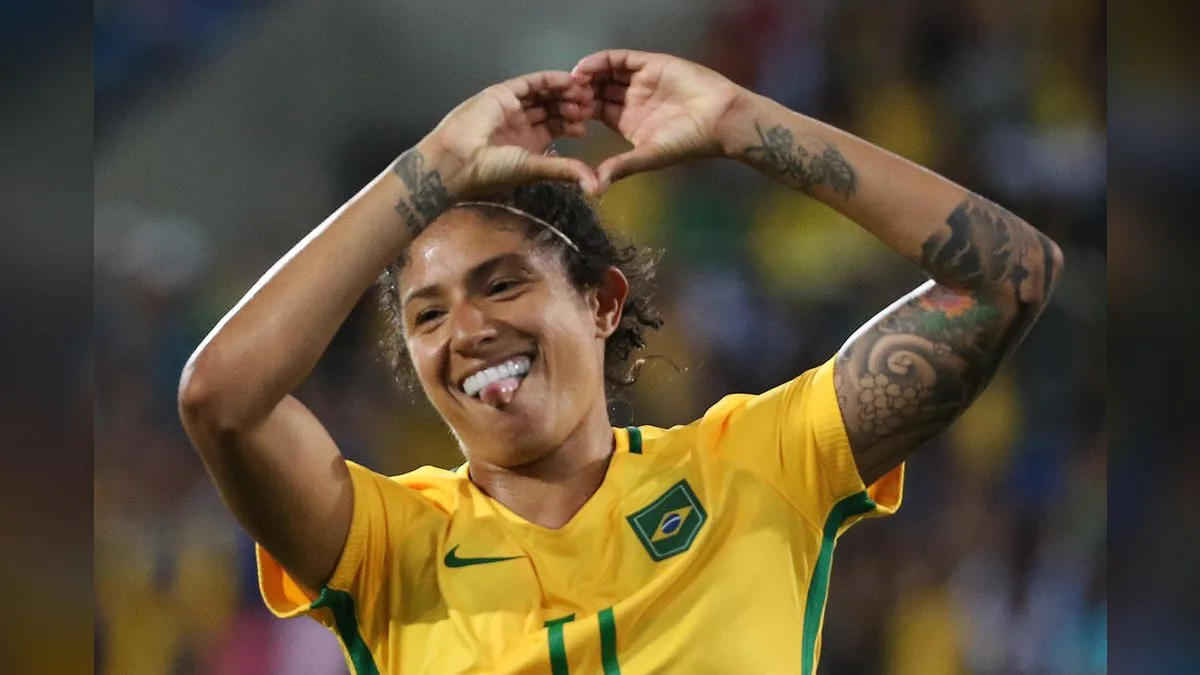
Cristiane Rozeira is one of Brazil’s most recognisable forwards across the 21st century. Her career traces a path from domestic clubs in São Paulo to top teams in Europe, Russia, South Korea, China and back to Brazil, and to a long international career that began in 2003. She formed a striking partnership with Marta through several Olympic cycles and became the kind of forward whose game read as much in the penalty area as it did on the stat sheet: movement, finishing and the knack for big goals.
| Born | 15 May 1985 |
|---|---|
| Nationality | Brazil |
| Position | Forward |
| Height | 1.71 m |
| National team | Brazil (2003–) |
Early steps and first moves abroad
Cristiane’s senior journey began at Clube Atlético Juventus in 2003, where she took the early steps that led to senior international recognition. Her first transfer to Europe came in 2005 when she joined 1. FFC Turbine Potsdam. That move exposed her to the physical and tactical standards of the Frauen-Bundesliga and offered regular matches against top opposition. A year later she stayed in Germany but joined VfL Wolfsburg for the 2006–2007 season, a period that consolidated her reputation as a forward who could adapt to different styles while remaining a consistent threat in the box.
Returns to Brazil, Scandinavian spell and move to the US
After her initial stint in Germany, Cristiane moved to Linköpings FC in Sweden in 2008, where she continued to develop the finishing skills that brought her international goals. She then returned to Brazil later in 2008 with S.C. Corinthians Paulista, showing a pattern that would recur across her career: alternating domestic spells with overseas contracts. In 2009 she took a step onto another continent, joining the Chicago Stars FC, where a busy schedule of matches helped keep her sharp for Brazil. That period included overlaps with spells at Santos FC, underlining how Cristiane balanced club continuity at home with opportunities abroad.
Football in Russia, Korea and back to Brazil
In 2011 Cristiane signed for WFC Rossiyanka in Russia, a move that brought the challenge of a very different league environment and the chance to test her game in colder climates and on varied turf. She returned briefly to Brazil with São José Esporte Clube in 2012 before moving again to Asia with Icheon Daekyo WFC in 2013. That mix of clubs shows a forward intent on maintaining a high level of competition and adapting to the professional opportunities that emerged in women’s football as markets in Russia, Korea and China expanded.
Prime years in Paris and Asia’s growing market
Cristiane moved to Paris Saint-Germain FC in 2015, a stage of her career when experience and technical ability met the tactical rigour of a leading European side. Her time in Paris is part of a late-career phase that also included a substantial contract in China with Changchun Zhuoyue from 2017. Those roles illustrate two trends in modern women’s football: the concentration of talent at established European clubs and the parallel rise of investment in Asian leagues offering lucrative, competitive alternatives for well-known internationals.
Later career and return to Brazil
After her spell in China Cristiane returned to Brazil for a short time with São Paulo FC in 2019 and later joined Santos Futebol Clube Amapá from 2020. These returns reflect a familiar pattern for South American players who balance international club opportunities with a desire to finish their careers closer to home. In Cristiane’s case, the later stages of her club career also allowed her to contribute to the domestic game’s visibility and to mentor younger forwards coming through Brazilian systems.
International career and reputation as an Olympic scorer
Cristiane made her senior Brazil debut in 2003 and built one of the longer international careers in the women’s game. She became especially associated with Brazil’s Olympic campaigns, partnering with Marta in attack across multiple tournaments and delivering a string of important goals at the Olympics. Her ability to find space in congested penalty areas, to convert half-chances and to score in knockout matches gave Brazil a reliable outlet when the team needed goals. Beyond the Olympics, she represented Brazil in World Cups and continental competitions, offering a mix of power, clever runs and clinical finishing.
Playing style: what she brought to a forward line
Cristiane’s game evolved from a young striker who relied on raw pace into an accomplished forward who combined several complementary traits. She reads the penalty area well, times her runs to exploit defensive gaps and prefers direct, decisive shooting. Physically she combined strength with balance, which helped her hold off defenders and win second balls. Equally important was her versatility: she could play through the middle or off a strike partner, and she adapted her movement depending on the tactical demands of the coach and the league.
Why Cristiane matters to the game
Cristiane’s significance is both sporting and symbolic. On the field she offered Brazil two decades of continuity in attack, a player capable of scoring at major tournaments and of linking with creative teammates. Off the field her career spans the era when women’s football professionalised unevenly across continents: she trod the pathway that many South American players took, moving between domestic teams and emerging markets abroad and, in doing so, helped demonstrate the international market for elite female forwards. Her longevity and her Olympic record make her part of Brazil’s modern football narrative alongside other leading figures.
Key qualities in brief
- Penalty area threat: A natural finisher who times runs and finds pockets of space where goals most often come.
- Physical presence: Uses strength and balance to protect the ball and to win duels against defenders.
- Adaptive player: Has fitted into varied tactical systems, from Brazil’s free‑flowing attack to Europe’s structured setups.
- Experience value: Brings a veteran’s reading of games that benefits teams in high‑pressure matches and assists younger players’ development.
Club career
| Years | Club | Apps | Goals |
|---|---|---|---|
| 2003–2005 | Clube Atlético Juventus | — | — |
| 2005–2006 | 1. FFC Turbine Potsdam | 19 | 7 |
| 2006–2007 | VfL Wolfsburg | 14 | 6 |
| 2008–2008 | Linköpings FC | 14 | 6 |
| 2008–2009 | S.C. Corinthians Paulista | 14 | 6 |
| 2009–2010 | Chicago Stars FC | 42 | 10 |
| 2009–2011 | Santos FC | 27 | 6 |
| 2011–2012 | WFC Rossiyanka | 14 | 6 |
| 2012–2012 | São José Esporte Clube | — | — |
| 2013–2015 | Associação Desportiva Centro Olímpico | 14 | 6 |
| 2013–2013 | Icheon Daekyo WFC | — | — |
| 2015–2017 | Paris Saint-Germain FC | — | — |
| 2017–2019 | Changchun Zhuoyue | — | — |
| 2019–2019 | São Paulo FC (women) | — | — |
| 2020– | Santos Futebol Clube Amapá | — | — |
Frequently asked questions
When did Cristiane start playing for Brazil?
Cristiane made her senior Brazil debut in 2003 and has remained part of the national setup across multiple tournament cycles. Her long run with the team includes World Cup and Olympic appearances where she scored important goals.
Which clubs did Cristiane play for in Europe?
Cristiane played in Germany with 1. FFC Turbine Potsdam and VfL Wolfsburg, in Sweden with Linköpings FC, in Russia with WFC Rossiyanka and later for Paris Saint-Germain FC in France. Those spells helped her adapt to different tactical demands and raised her profile internationally.
What type of forward is Cristiane?
Cristiane is primarily a penalty‑area forward who times runs and finishes decisively, combining physical strength with a direct style of play. She can play centrally or alongside a partner, bringing experience and clinical finishing to high‑pressure matches.
