
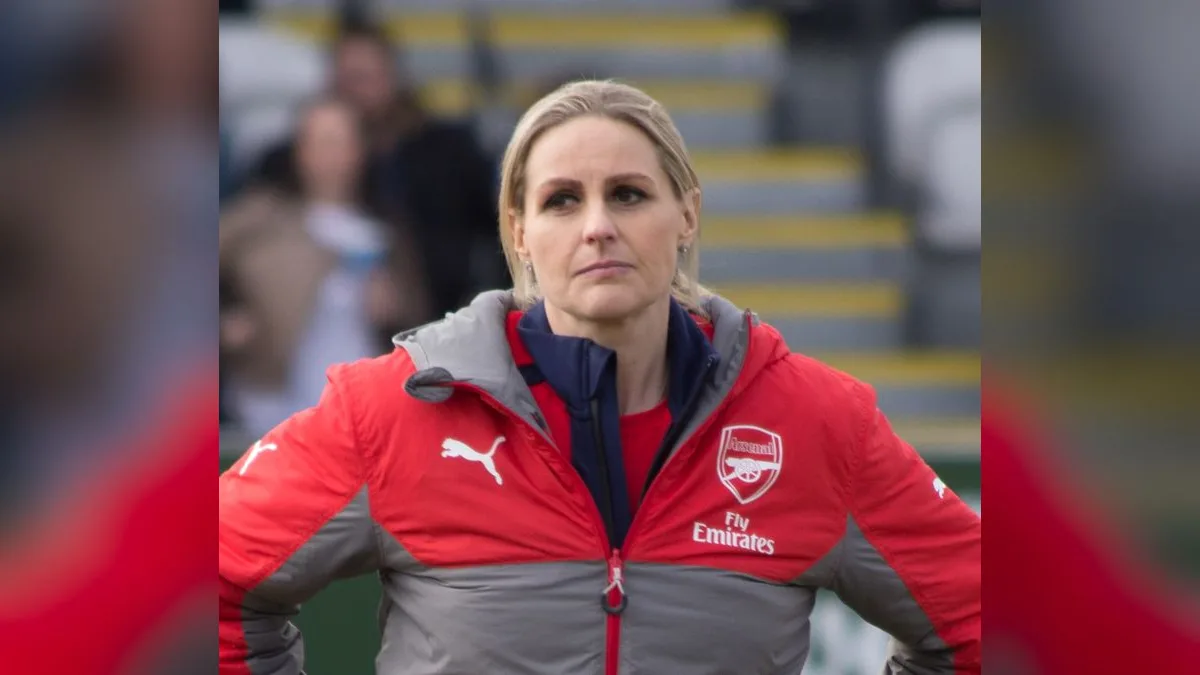
Kelly Smith emerged from England’s grassroots scene and became the touchstone for technical excellence in the women’s game before full professionalism arrived. Her career threaded college soccer in the United States with repeated returns to Arsenal, long spells in American leagues, and an international decade that made her the leading light of England’s attack. Smith’s story is not only about goals; it is about a style that changed what coaches and fans expected from an English forward.
| Born | 29 October 1978 |
|---|---|
| Nationality | United Kingdom |
| Position | Forward |
| Height | 1.68 m |
| National team | England (1995–2015) — 117 caps, 46 goals |
Early years and breakthrough
Smith’s early steps combined local development with an unusual route through the American college system. After coming through the youth pathway associated with Arsenal, she left for the United States to join Seton Hall Pirates in 1997. The move proved formative: the college environment gave her space to sharpen ball control, to work on first touch under pressure, and to play regularly against athletic opponents. That period made Smith a visibly different forward when she returned to the English game.
Her first senior association with Arsenal dated from the mid-1990s, and although the women’s game in England then lacked the structures it has now, Smith’s talent was obvious. She combined pace of thought with a gift for stringing short passes together in tight corridors. These traits would define her play when she rejoined Arsenal in later years.
Club career across two continents
Smith’s club life alternated between England and the United States in a way that broadened her football education. After her college spell at Seton Hall, she played for the New Jersey Lady Stallions and then entered the first significant professional domestic competition available to her, the WUSA, turning out for Philadelphia Charge. That league was an early professional experiment in the US and exposed Smith to a higher tempo and different tactical systems. Her subsequent spells with New Jersey Wildcats and later with Boston Breakers kept her in American competition while she remained a headline name for Arsenal when back in England.
Each return to Arsenal marked a new phase. Her second spell from 2005 re-established her as the club’s leading attacker and showed how her U.S. experience had changed her game: she combined English close control with an increased physical robustness and sharper positional sense. A final Arsenal period began in the 2010s as the women’s game in England moved toward a more professional model; Smith’s presence linked two eras at the club and gave younger team-mates a living example of technical mastery.
International career and influence
Smith’s England career stretched across two decades and made her one of the defining forwards of her generation. She debuted as a teenager and went on to become central to England’s attacking identity. Her strengths were not limited to finishing; she excelled at creating chances from tight angles, dropping between lines to spark play, and finding long diagonals that bypassed organised defences. For England, she was the player who could tilt matches through individual invention as well as controlled combinations.
Her longevity at international level also mattered. Smith became a role model for players who wanted to be technically accomplished without sacrificing competitive edge. She featured in major tournaments and was part of the domestic conversation that pushed English football toward better investment in the women’s game. That legacy is tactical as much as symbolic: coaches began to plan sides around players comfortable on the ball in congested areas, a trend Smith personified.
What she did on the pitch
Smith’s football intelligence and touch set her apart from many forwards of her era. She combined several complementary qualities that made her difficult to defend against. Her best games came when the team asked her to occupy half-spaces, link midfield to attack, and play quick one-twos in the final third. She could run in behind but equally relished receiving with her back to goal and turning defenders with close control. Her long-range shot and timing of late runs into the box were additional weapons when teams crowded the central channels.
Technically, Smith was notable for her first touch under pressure and her ability to manipulate the ball in tight yards. Tactically, her intelligence showed in the ways she could pull defenders out of position and create space for team-mates. That combination made her both a goal threat and a creator, a forward who improved the players around her as well as finishing moves herself.
Attributes and playing style (list)
- First touch: A control that neutralised pressure and allowed immediate forward tempo, turning potential losses of possession into sustained attacks.
- Spatial awareness: An ability to find and exploit half-spaces so that runs and passes came from unexpected angles.
- Creative passing: Short passing sequences and through-balls that opened compact defences and created high-quality chances.
- Finishing variety: Comfort both with long-range efforts and late arriving runs into the box, giving multiple routes to goal.
- Mental resilience: The adaptability to perform in different competitions and tactical setups across two continents.
Why Kelly Smith matters to the game
Smith’s career bridged amateur and professional eras and showed what a forward built on technique could achieve against physically dominant opponents. Her presence in English football helped normalise the idea that technical flair and tactical intelligence were essential at the highest level, not optional extras. Young players who wanted to base their game on skill could point to Smith and see a viable path to international prominence.
Beyond the pitch, Smith’s movement between the English and American games linked two developmental models. She demonstrated that English talent could thrive in professionally organised leagues and that the skills learned there could enrich domestic football when players returned home. That cross-pollination contributed, in small but crucial ways, to the evolution of coaching priorities and player development in England.
Lasting reputation
Smith is remembered primarily as a technical pioneer: the forward whose natural touch, passing range and movement prefigured a newer, more skilful generation. Her career also stands as a template for players navigating transatlantic opportunities at a time when England’s domestic game offered limited professional options. For supporters and coaches alike, Smith remains an example of how technique and intelligence can shape matches and, over time, influence the structure of the sport itself.
Club career
| Years | Club | Apps | Goals |
|---|---|---|---|
| 1995–1997 | Arsenal F.C. | — | — |
| 1996–1997 | Arsenal W.F.C. | — | — |
| 1997–1999 | Seton Hall Pirates | 51 | 76 |
| 1999–2000 | New Jersey Lady Stallions | — | — |
| 2001–2003 | Philadelphia Charge | 26 | 9 |
| 2004–2004 | New Jersey Wildcats | 8 | 8 |
| 2005–2009 | Arsenal W.F.C. | 66 | 73 |
| 2009–2012 | Boston Breakers | 45 | 18 |
| 2012–2017 | Arsenal W.F.C. | 23 | 9 |
| 2012–2012 | Great Britain women’s Olympic association football team | 4 | 0 |
Frequently asked questions
What position did Kelly Smith play?
Kelly Smith was a forward who combined finishing with creative link play. She often occupied half-spaces, dropping between lines to create chances as well as scoring herself.
Which clubs did Kelly Smith play for?
Smith’s club career included multiple spells at Arsenal and several teams in the United States, where she played college soccer and in professional leagues. Her moves gave her experience of different tactical and physical styles.
How did Kelly Smith influence England women’s football?
Smith changed expectations for technical excellence among English attackers and demonstrated the value of combining flair with tactical discipline. Her career also illustrated how playing abroad could raise standards back home.
