
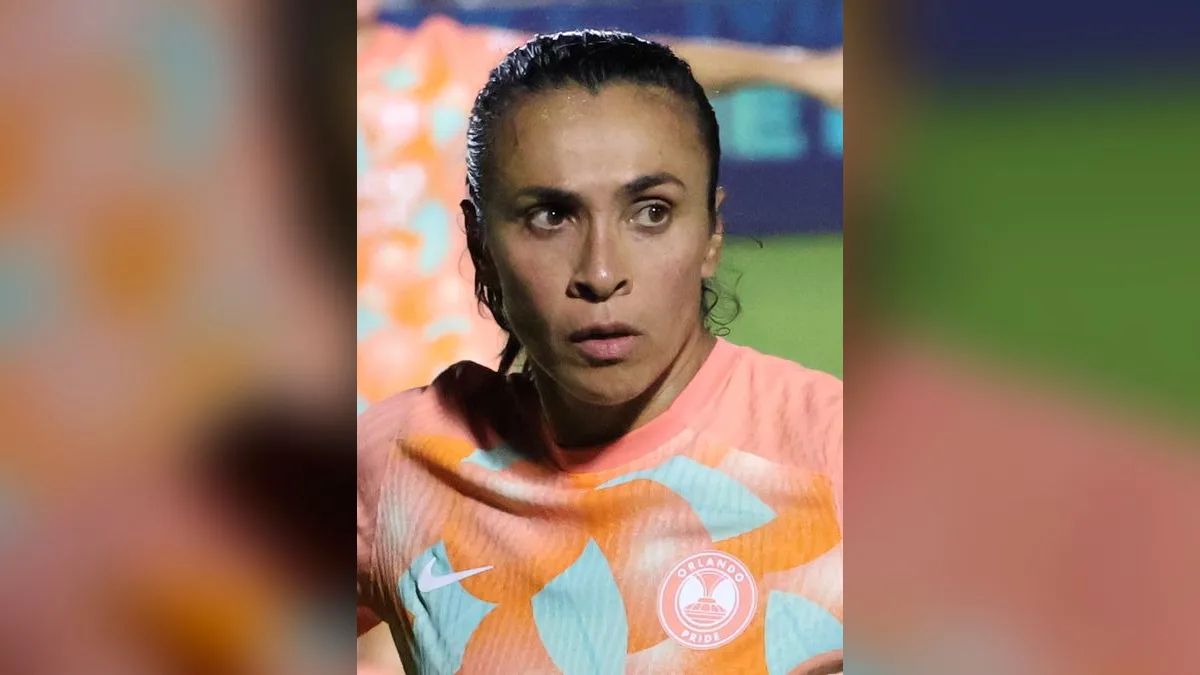
Marta Vieira da Silva’s career traces a clear line: from a gifted child in Alagoas playing wherever a ball would roll, to the defining attacker of her era. A six-time FIFA World Player of the Year and the all-time leading scorer at Women’s World Cups, she set standards that shaped how the game is played and perceived.
| Born | 19 February 1986 |
|---|---|
| Nationality | Brazil |
| Position | Forward |
| Height | 1.62 m |
| National team | Brazil (2002–2024) |
Beginnings in Alagoas
Born in Dois Riachos in Brazil’s northeast, Marta grew up far from the country’s traditional football centres. Space was limited and the structures for girls were thin, but her touch and balance marked her out early. She learned the game in mixed and boys’ settings, forced to solve problems quickly and keep the ball under pressure. That education shows in her first touch and in the way she rolls opponents off her hip.
As a teenager she moved to Rio de Janeiro, joining a women’s team linked to one of the country’s leading clubs. The step from improvised pitches to a professional environment was sudden. She handled it by leaning on her strengths: left-footed control, acceleration over the first few strides, and a willingness to carry the ball into tight spaces. Before long, scouts in Europe noticed.
Umeå and the making of a superstar
Her transfer to Umeå IK in Sweden was pivotal. The move brought rigorous training rhythms, long seasons at the top of the table, and regular European competition. Umeå trusted her as a difference-maker from the start, surrounding her with a possession-heavy structure that maximised her ability to receive between the lines and turn.
In Sweden she became a complete forward. The raw dribbler from Alagoas added timing and economy to her game. She learned when to release the ball, when to slow a move to draw in defenders, and when to run beyond the last line. Domestic titles followed, as did deep runs in Europe. By her early twenties, she was already a global reference point for creativity and end product, recognised with a run of FIFA World Player of the Year awards from 2006 through 2010.
Crucially, this phase refined her positional range. She stopped being just a left-sided attacker and became a free 10 or second striker, linking midfield to the box. That versatility would lengthen her career at the top level.
The U.S. leap and a return to Sweden
The launch of Women’s Professional Soccer in the United States gave Marta a new stage and a new set of opponents. With Los Angeles Sol, then FC Gold Pride, and later Western New York Flash, she was the headline act. The tempo was faster and more direct than in the Damallsvenskan. Marta adapted by sharpening her running off the ball and carrying attacks in transition. Her teams won, and she took home major individual honours in that short-lived but influential league.
When WPS folded, she returned to Sweden. Tyresö FF built around her and reached the UEFA Women’s Champions League final in 2014, a breathless match decided by a single goal swing. Financial problems ended that project, but she stayed in the country with Rosengård and kept collecting domestic silverware. The pattern repeated: put Marta in a competitive environment with a clear structure, and a title race tends to follow.
Her move to the NWSL with Orlando Pride added another chapter. A league stacked with pace and athleticism asked her to adjust again. She did so by dictating rhythm, using her body to shield under pressure, and choosing moments to break lines with a burst or a disguised pass. Even as speed in behind ceased to be her primary weapon, the vision and touch remained.
Brazil: goals, finals, and a benchmark
For Brazil, Marta made the leap from precocious talent to national standard-bearer within a few years. She played at the 2003 Women’s World Cup as a teenager and won Olympic silver in 2004. The 2007 World Cup became a personal showcase: a Golden Boot and a Golden Ball, and a Brazil side that reached the final with a flowing, incisive style. Another Olympic silver arrived in 2008.
Knockout football rarely yields perfect endings. Brazil often ran into a disciplined opponent by the finest of margins. Across the cycles, Marta provided the constant. She scored at five different Women’s World Cups, the first player to do so, and set the tournament scoring record. She also helped Brazil lift multiple Copa América titles and Pan American Games golds, achievements that sustained the programme’s standing in South America through years of uneven investment.
Leadership grew alongside the goals. The armband came with extra weight: connecting generations, shouldering expectations, and often addressing the wider responsibilities that come with being the face of a team. Her influence ran beyond matchdays, toward the conditions needed for Brazil’s next wave to thrive.
What Marta actually does on the pitch
Marta’s game starts with balance. She carries her centre of gravity low, rides contact, and comes out of duels with the ball still at her feet. The dribbling is not just flair. It is a tool to shift defenders one step, open a lane, and play on the half-turn. A trademark move sees her receive on the left, dip inside with a feint, and drive toward the box to shoot with her left or slip a runner through.
She is also a connector. As a 10, she drops between midfield and defence, receives on the half-space, and switches play with her laces. The weight of pass is precise, often one tempo slower than expected to lead a teammate beyond the covering defender. In crowded areas she uses sole-and-instep touches to manipulate angles. Set pieces add a further layer: a clean, controlled strike from free-kicks and penalties, and a calm approach under stress.
Tactically, Marta has moved with the game. Early on she lived high on the left, looking to isolate full-backs. Later she occupied central pockets and did more off-ball work to screen passing lanes. In leagues where pace dominates, she chooses her moments, conserving energy for the actions that decide matches. The throughline is decision-making under pressure.
Why she matters
Marta is a measure, as much as a star. For more than a decade, coaches and players could point to a match clip and say: this is what top-level attacking play looks like. The six FIFA World Player of the Year awards, split between an early run and a later resurgence, reflect a career with two peaks rather than just one extended prime. That longevity is rare in any era.
Her influence travels beyond Brazil. She helped make Sweden a destination for elite talent, then carried star power into American leagues that needed recognisable figures to grow. In each stop she raised standards: training intensity, tactical detail, and the expectation that skill must become production. Off the pitch, she has been a leading voice for investment and respect in the women’s game, insisting that visibility and opportunity be built, not assumed.
The record at the Women’s World Cup endures because it came in different roles and against different styles of opponent. Few players have reinvented themselves so smoothly while staying central to a national team’s identity for so long. That, more than any single goal or award, explains Marta’s standing: a career that shaped the sport and a game that still teaches it.
Club career
| Years | Club | Apps | Goals |
|---|---|---|---|
| 2000–2002 | CR Vasco da Gama | 16 | 4 |
| 2002–2004 | Santa Cruz Futebol Clube | 38 | 16 |
| 2004–2008 | Umeå IK | 103 | 111 |
| 2009–2009 | Los Angeles Sol | 19 | 10 |
| 2009–2010 | Santos FC | 14 | 26 |
| 2010–2010 | FC Gold Pride | 24 | 19 |
| 2011–2011 | Santos FC | 12 | 13 |
| 2011–2011 | Western New York Flash | 14 | 10 |
| 2012–2014 | Tyresö FF | 35 | 24 |
| 2014–2017 | FC Rosengård | — | — |
| 2017– | Orlando Pride | — | — |
Frequently asked questions
Who is Marta and why is she considered an icon in women’s football?
Marta rose from modest beginnings in Brazil’s northeast to become one of the defining attackers of her generation, winning multiple FIFA World Player of the Year awards. Her career set standards for attacking play, influenced how the game is taught, and helped raise the profile of women’s football internationally.
What are Marta’s main strengths and how does she play on the pitch?
Her game is built on exceptional balance, close control and a left-footed finishing threat, combined with the ability to dribble out of tight spaces and create chances. Over time she added tactical intelligence—dropping into pockets, timing runs, and choosing moments to break lines—while also delivering precise set pieces under pressure.
What major achievements has Marta had with clubs and the Brazil national team?
At club level she became a complete forward who won domestic titles, reached Champions League finals, and was a headline player in both Sweden and the United States. For Brazil she scored across multiple World Cups to become the tournament’s all-time top scorer, earned Golden Ball and Golden Boot recognition in a World Cup, and helped secure continental and Pan American honours while captaining and guiding the national team.
