
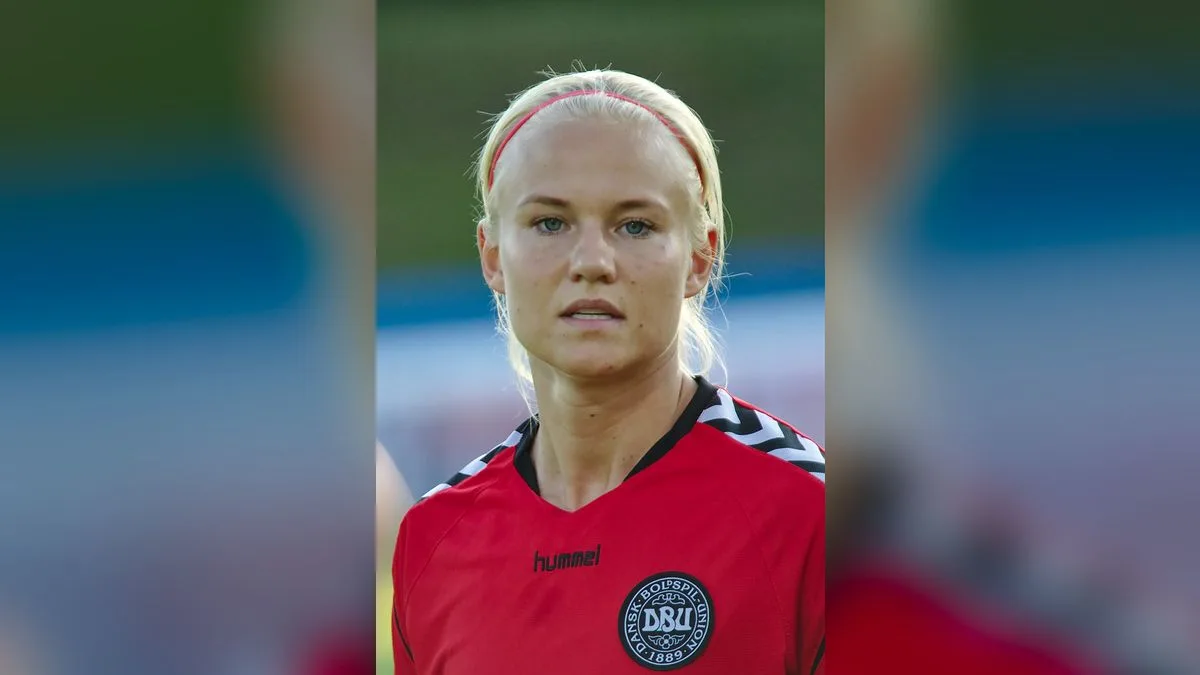
Pernille Harder has combined an eye for goal with midfield craft to become Denmark’s defining player of her generation. Born on 15 November 1992, she emerged from the Danish league before establishing herself as a leading figure in Sweden, Germany and England. Harder’s career maps a steady climb: from a prolific young forward at IK Skovbakken to a complete attacking midfielder trusted to carry creative and goalscoring responsibilities at top European clubs. On the international stage she is a long-serving presence for the Denmark women’s national football team, a player around whom the side has often rotated its attacking plans.
| Born | 15 November 1992 |
|---|---|
| Nationality | Denmark |
| Position | Midfielder |
| Height | 1.68 m |
| National team | Denmark (2009–) — 123 caps, 64 goals |
Early years and the breakthrough at IK Skovbakken
Harder started her senior career in Denmark and broke through at IK Skovbakken, joining the senior squad in 2010. From the start she combined mobility and finishing instincts in a way that set her apart from peers. At Skovbakken she played as a forward and attacking midfielder, a role that let her exploit late runs from deep and get in behind defences. The club provided a platform where she could sharpen movement, timing and finishing against experienced domestic opposition, and those years laid the technical and tactical groundwork for her next step abroad.
Establishing herself in Sweden with Linköpings FC
Harder moved to Linköpings FC in 2012. The Swedish Damallsvenskan imposed a higher tactical tempo and physical standard, and the switch demanded refinement in her game. At Linköping she developed a more complete attacking midfield profile: better combination play, a keener sense of when to drop into pockets of space, and the ability to shift between creating and finishing opportunities.
Her time in Sweden was important for another reason. Linköpings regularly competed for domestic honours and against strong opposition, which exposed Harder to matches that required consistency and game management. That experience hardened her mentally and expanded her repertoire. The move also raised her visibility across Europe, setting up the transfer that would test her at the game’s highest club level.
Peak development at VfL Wolfsburg
In 2017 Harder signed for VfL Wolfsburg, a club already established among Europe’s elite. The Frauen-Bundesliga and the Champions League presented a new standard of opposition, where every defensive unit was compact and every chance had to be manufactured. Wolfsburg’s environment required technical excellence under pressure and an ability to exploit tiny openings—qualities Harder supplied.
At Wolfsburg she evolved into a player who could dominate a match in multiple phases. Her movement off the ball, ability to connect play between lines, and precision in finishing became more consistent. The German period also taught her how to shoulder responsibility in big games: against organised defences she learned to vary tempo, to drop and collect the ball when necessary, and to arrive in the box with timing that unsettled centre-backs. Those traits underpinned the recognition that followed her while at the club.
Major attributes and on-pitch profile
- Late runs: Harder times her arrivals into the box to avoid markers and create clear shooting opportunities.
- Finishing variety: She can finish with either foot and from several ranges, making her threat unpredictable.
- Compact link-up: Comfortable receiving in tight spaces, she combines short passes to unlock defences.
- Set-piece presence: She contributes to dead-ball routines both as a taker and a target, adding an extra dimension to attacking patterns.
- Game intelligence: Readiness to change position during a match allows her team to shift between narrow and wide attacking shapes.
Together these traits explain why coaches have used Harder in roles that ask both for goals and for creative responsibility. She is not a pure number-nine nor a pure creator; she blends the two and often becomes the decisive player in transition and late phases of attack.
Chelsea and the move to the English game
Harder joined Chelsea F.C. Women in 2020, taking her game to the English top flight. The WSL presents a hybrid challenge: physical duels, rapid transitions and tactical variety from opponents. At Chelsea she continued to be used as an advanced midfield presence who also finishes chances. Her arrival represented a move into a league where squad depth and fixture congestion test adaptability and fitness, and where every team offers different defensive profiles to break down.
The English chapter has required adjustments too. High-intensity pressing and frequent contests for the ball mean decisions must be made quicker; Chelsea’s style has asked Harder to apply her link-up play in tighter windows and to develop even greater speed of execution in passing and movement. The transfer also broadened her experience of playing styles across Europe and added another layer to the argument that she is among the continent’s most complete attacking midfielders.
International career and why she matters
Harder made her Denmark senior debut as a teenager and has remained part of the national setup since 2009. Over more than a decade she has combined leadership with consistent attacking output, occupying a central role in the national team’s tactical plans. Her international record places her among Denmark’s most potent attackers. The long-term presence at national level has also made her a reference point for younger Danish players and a key figure in shaping how Denmark approaches the attacking phase.
Beyond statistics, Harder matters because she represents a modern attacking midfielder who balances creativity with genuine goal threat. Her career trajectory—from the Danish league to Sweden, Germany and England—charts the pathway available to ambitious players from smaller footballing nations. At each step she adapted, added new layers to her game and left a mark at club and international level.
Legacy and influence
Twice named the best player in Europe, Harder has become a yardstick for versatility in attack. Her career shows how an attacking midfielder can be measured by goals and by the ability to change games through movement and decision-making. For Denmark she is a generational figure; for clubs she has been a match-winner and a player around whom tactical plans can be built.
Young attacking players studying Harder will find a model in technical precision, intelligent movement and the willingness to adapt roles. Those qualities, more than any single statistic, explain why she is regarded as one of Europe’s leading players and Denmark’s all-time great.
Club career
| Years | Club | Apps | Goals |
|---|---|---|---|
| 2010–2012 | IK Skovbakken | 27 | 22 |
| 2012–2016 | Linköpings FC | 88 | 71 |
| 2017–2020 | VfL Wolfsburg | 75 | 68 |
| 2020– | Chelsea F.C. Women | 16 | 7 |
Frequently asked questions
What position does Pernille Harder play?
Pernille Harder is primarily an attacking midfielder who also plays in advanced forward roles. Her game mixes creative link-up play with a strong goalscoring instinct.
How long has Pernille Harder played for Denmark?
Harder made her Denmark senior debut in 2009 and has been a regular presence in the national team since then. She combines leadership with sustained attacking output across a long international career.
Which clubs has Pernille Harder played for?
Harder began at IK Skovbakken before moving to Linköpings FC in 2012, then to VfL Wolfsburg in 2017, and she signed for Chelsea F.C. Women in 2020. Each move marked a step up in competition and responsibility.
