
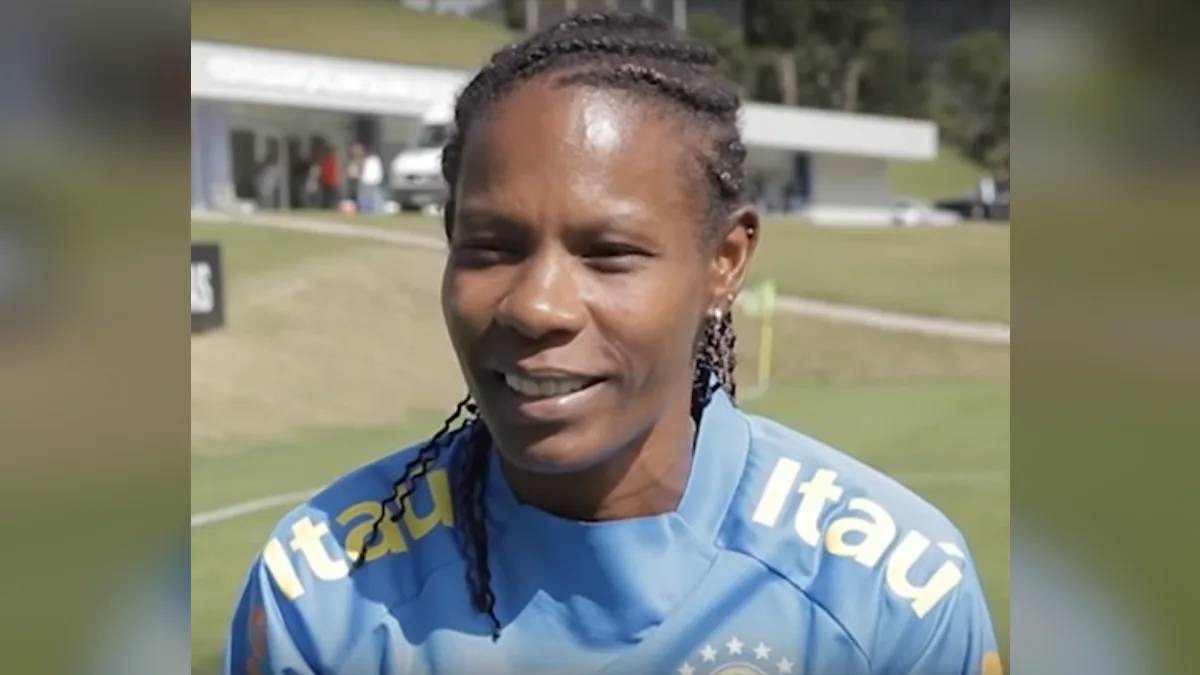
Early years and breakthrough
Born in 1978, Formiga emerged into organised football at a time when opportunities for girls in Brazil were limited. Her senior club career began with São Paulo FC in 1993, where she spent the formative years learning the midfield craft that would define her game. A move to Associação Portuguesa de Desportos followed in 1998 and marked the first step away from the club where she had grown up as a player. Those early seasons established her as a reliable, energetic presence at the base of midfield and set the tone for a remarkably long international life.
| Born | 3 March 1978 |
|---|---|
| Nationality | Brazil |
| Position | Midfielder |
| Height | 1.62 m |
| National team | Brazil (1995–2011) — 117 caps, 13 goals |
Establishing an international identity
Formiga entered the Brazil senior set-up in 1995 and remained a fixture until 2011. Over that period she collected 117 caps and scored 13 goals for the national side. Her international career is most often measured by its longevity: she became the first player to appear in seven consecutive FIFA Women’s World Cups, a run that stretched across three separate decades. That accomplishment reflected more than fitness; it reflected a tactical intelligence and adaptability that allowed her to stay relevant as teams and systems evolved.
Club journey: Sweden, the United States and back to Brazil
Formiga’s club career after the 1990s reads as a tour of the options available to elite Brazilian players. In 2002 she had two brief spells with Santos F.C., then in 2003 she joined Serra Macaense Futebol Clube. The move abroad came in 2004 when she signed for FC Rosengård in Sweden, where the professional environment and emphasis on tactical discipline accelerated her development in a new way.
From Sweden, Formiga spent several seasons in the United States with teams in different leagues. In 2006 she played with the New Jersey Wildcats, recording a notable goals return in the appearances recorded for that season, and in 2007 she played for the Hudson Valley Quickstrike Lady Blues before returning to Brazil with Saad Esporte Clube and then Botucatu Futebol Clube in 2008. She later featured in the American professional leagues with FC Gold Pride in 2009 and Chicago Stars FC in 2010. Each stop added a different element to her game: physical intensity in the U.S., positional refinement in Sweden, and leadership on her returns to Brazil.
In 2011 Formiga joined São José Esporte Clube and remained there for a decade. That tenure anchored the latter phase of her career and allowed her to combine club stability with continued international commitments during the earlier part of that period. The long spell at São José Esporte Clube also became the environment where she could mentor younger players while maintaining the standards that had kept her at the top level for so long.
What she did on the pitch
Formiga played as a midfielder with a distinctive mix of attributes. She operated primarily as a deep-lying playmaker and ball-winner, using positioning and anticipation to break opposing attacks and to start transitions. Her passing range was conservative rather than spectacular; she focused on the accuracy and timing required to keep possession and to link defence and attack. Stamina and work-rate were essential features of her game. Those physical qualities allowed her to cover large areas of the pitch and to offer reliable protection in front of the back line.
Beyond the measurable skills, Formiga brought a stabilising presence. She read the game well and rarely made the kind of errors that cost possession in dangerous areas. That consistency was a large part of why coaches continued to select her for major tournaments across different tactical systems. She was not a high-scoring midfielder, but her contributions came in control, tempo management and defensive balance—roles that do not always appear in headline statistics but are decisive over the course of tournaments and seasons.
Leadership and legacy
Formiga mattered as much for what she represented as for what she produced. Appearing in seven consecutive World Cups made her a visible symbol of professional longevity and resilience in women’s football. Her career spanned eras when the structure, visibility and support for the women’s game changed substantially. That continuity gave younger teammates and the wider Brazilian women’s game a recognisable professional benchmark.
Her long-term presence at São José Esporte Clube allowed Formiga to pass practical knowledge to a new generation of players. On a structural level, her moves abroad and back again demonstrated pathways for Brazilian players seeking higher standards and professional experience overseas, and then returning home to strengthen domestic clubs. The pattern of her career — early domestic grounding, spells abroad to refine craft, and a sustained final phase at a domestic club — is now familiar, but she was among the players who modelled it for those who followed.
Playing profile — quick points
- Role clarity: A disciplined deep-lying midfielder whose primary job was balance and ball circulation rather than attack-minded creativity.
- Game intelligence: Anticipation and positioning allowed her to intercept play and initiate transitions without relying on raw pace.
- Durability: Longevity at international level across multiple tournament cycles proved her physical and mental resilience.
- Mentorship: Long spells at São José Esporte Clube and repeated returns to Brazil positioned her as a leader and mentor later in her career.
- Adaptability: Successful spells in Sweden and the United States showed an ability to adapt to different tactical demands and professional environments.
Why she matters to the game
Formiga’s career matters because it bridges eras. She was a constant for Brazil during a time when the women’s game moved from intermittent opportunity to regular international competition and growing professional structures. Appearing at seven World Cups gave her a rare longevity record, but the deeper significance lies in her role-model status within Brazilian football: a player who combined domestic loyalty with the willingness to test herself abroad. That combination helped normalise the cross-border movement of Brazilian women players and contributed to the professionalisation of clubs that could benefit from experienced returnees.
Her legacy is not wrapped in a single iconic moment. It is spread across tournament after tournament, season after season, in the small, steady acts of a midfield player who kept teams balanced. For players whose primary contribution is control rather than flash, Formiga offers a clear blueprint: professional standards, adaptability to different leagues, and the kind of longevity that changes expectations about how long a woman can play at the highest level.
Club career
| Years | Club | Apps | Goals |
|---|---|---|---|
| 1993–1997 | São Paulo FC | — | — |
| 1998–1998 | Associação Portuguesa de Desportos | — | — |
| 2002–2002 | Santos F.C. | — | — |
| 2002–2002 | Santos FC | — | — |
| 2003–2003 | Serra Macaense Futebol Clube | — | — |
| 2004–2005 | FC Rosengård | — | — |
| 2006–2006 | New Jersey Wildcats | 12 | 13 |
| 2007–2007 | Hudson Valley Quickstrike Lady Blues | 6 | 1 |
| 2007–2007 | Saad Esporte Clube | — | — |
| 2008–2008 | Botucatu Futebol Clube | — | — |
| 2009–2009 | FC Gold Pride | 16 | 0 |
| 2010–2010 | Chicago Stars FC | 23 | 0 |
| 2011–2021 | São José Esporte Clube | — | — |
| 2012–2012 | São José Esporte Clube | 16 | 0 |
Frequently asked questions
How many World Cups did Formiga play in?
Formiga appeared in seven consecutive FIFA Women’s World Cups, a run that extended across three decades and made her one of the sport’s longest-serving tournament players.
What position did Formiga play?
Formiga played in midfield, typically operating in a deep-lying role where her anticipation, passing and defensive balance were the primary contributions to her teams.
Which clubs did Formiga join after 2000?
After 2000 she had spells with Santos F.C. and Serra Macaense, played for FC Rosengård in Sweden, featured for several U.S. clubs including New Jersey Wildcats and FC Gold Pride, and later spent a decade at São José Esporte Clube.
