
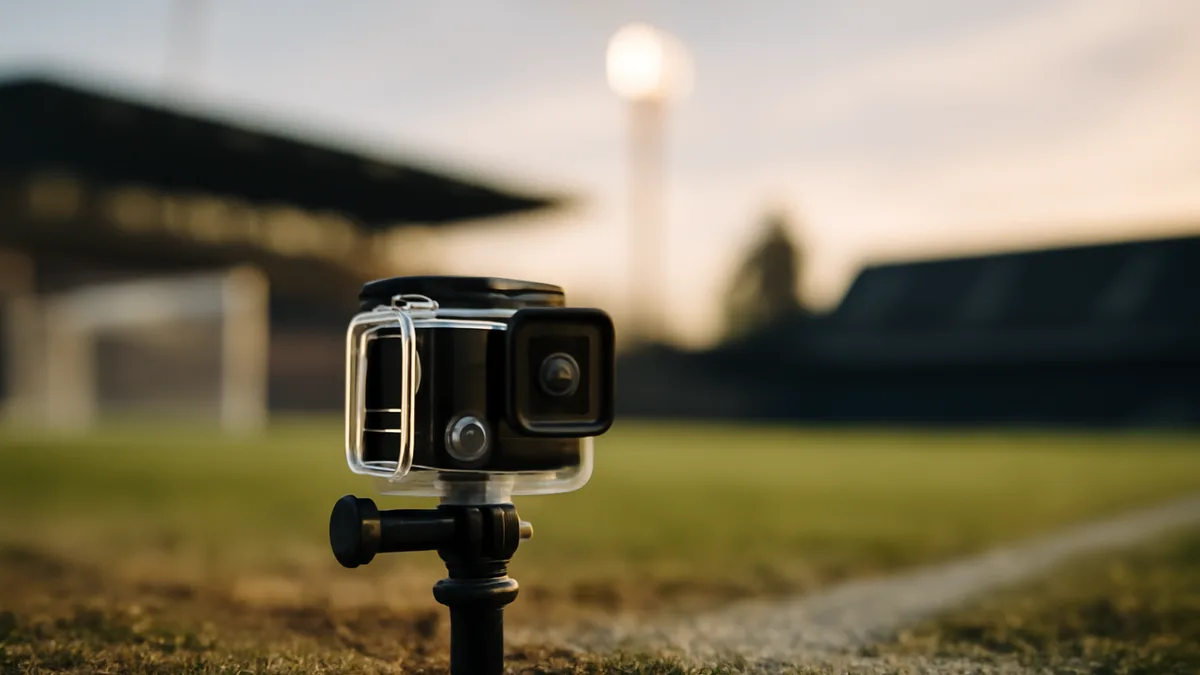
Filming a match with an action camera demands different choices from shooting training, vlogging or riding a bike. The decision turns on how far the camera will be from the play, how long it must run without attention, and whether footage will be edited into highlights or simply archived.
This guide lists the priorities in the order they matter for most club and grassroots fixtures. Each section stands on its own so a buyer can jump to the point they care about most.
Key checks before buying
Field of view
Choose a camera whose lens covers the angle of the pitch you need without heavy panning. Wide-angle optics capture more of the playing area from a single fixed position but introduce perspective distortion and make players at distance smaller; 360-degree models remove framing decisions entirely by letting the operator reframe in post-production. Match the lens choice to the mounting distance: a narrow FOV can suffice from a low sideline but will miss action when placed high behind goal.
Battery life and power options
Battery duration is the single biggest practical limiter for unattended match filming. Select a camera that can run continuously for the length of the game, or plan for accessible hot-swap batteries or an external USB power supply. Consider whether the camera supports in-camera power management—automatic shut-off options, timed recording or USB power passthrough—so recording does not stop at a crucial moment.
Storage capacity and codecs
Recording resolution and frame rate determine how much storage a match consumes; higher frame rates for slow-motion or higher bitrates for cleaner footage both increase file sizes. Pick a camera that supports common efficient codecs and robust microSD card standards; check whether it can record long files without splitting and whether cards can be swapped quickly during breaks. For archiving, prefer cameras that allow removable media rather than internal-only storage.
Mounting height and angle
Mounting height changes what the lens must do: a low sideline mount needs less vertical coverage but benefits from a narrower FOV, while a high stand or roof mount needs a wider FOV to avoid isolating small figures. Secure mounts and a stable platform are more important than a marginally better sensor when a camera is up high, because vibration and wind ruin usable footage. Plan the physical mount first, then pick a camera whose focal length and mounting options match that height.
Image stabilisation and electronic aids
Effective stabilisation compensates for wind, shaking and minor tripod vibration and can mean the difference between usable and unusable clips. Some action cameras combine hardware stabilisation with software correction; others rely on lens crop to stabilise. If the plan is to reframe or zoom in post-production, stronger stabilisation preserves detail when cropping and should be prioritised over sensor size.
Low-light performance and dynamic range
Matches at dusk or under improvised floodlights require a sensor and processor that handle high contrast and retain detail in shadows and highlights. A camera with a larger sensor or a proven line known for good low-light imaging will hold up better when conditions deteriorate. If evening fixtures are frequent, place this criterion near the top of the list.
Form factor and durability
Action cameras are designed to be compact and robust, which helps when mounting in exposed positions or transporting the kit. Consider water resistance, easy access to ports and buttons when the camera is in its cage or mount, and the availability of protective housings for harsh weather. A small, rugged body that can be remotely triggered is often more useful than a heavier camera with marginally better image quality.
Connectivity and remote control
Wireless control, reliable live preview and the ability to offload files without removing the card simplify match-day workflows. Cameras with stable Wi‑Fi or Bluetooth ecosystems and companion apps allow framing checks from the touchline and remote start/stop if the operator cannot access the device during play. Also check whether the camera supports wired live output for a direct feed into a recorder or switcher when broadcasting or building a multi-camera setup.
Comparing common approaches
| Field of view | Stabilisation | Ease of reframing | |
|---|---|---|---|
| Single wide-angle action camera | Wide coverage from one mount but more distortion at edges. | Often strong in-body electronic stabilisation. | Limited — crop loses detail at distance. |
| 360-degree camera | Complete capture; no missed angles if mounted centrally. | Stabilisation is generally excellent and works on the whole sphere. | Excellent — reframe in post with freedom to track play. |
| Multiple fixed cameras | Combined coverage tailored to pitch zones. | Depends on each unit; tripod stability matters most. | Very good — switching between cameras preserves resolution. |
How to decide
Start by defining the use case: archive footage for coaching, clips for social media, or a live feed. If recordings are primarily for analysis, prioritise wide coverage and high frame rates for replay; for highlight reels, choose better low-light performance and reframing flexibility. Consider logistics: who will carry spare batteries, who can access the mount during halftime, and whether the club has a power source at the intended mounting point.
Where people go wrong
Buyers often pick the camera with the highest advertised resolution without checking battery life or how long it can record continuously. Another common mistake is underestimating mounting challenges: a low-cost clamp or flimsy tripod yields shaky footage even with a good sensor. Lastly, ignore file management at match day at a cost — insufficient storage or slow offload routines create bottlenecks that ruin a weekend’s worth of footage.
Beginner versus experienced buyer
A beginner should favour simplicity: a rugged, easy-to-mount camera with reliable wireless preview and long battery life reduces setup errors. Experienced buyers can prioritise features that aid post-production, such as higher bitrates, external audio options, multi-camera synchronization and 360 capture for reframing. Clubs planning to scale up should also consider systems that integrate with external recorders and switchers.
What to do next
Decide the mounting height and the coverage needed first. Then shortlist cameras that match the required field of view and whose battery and storage workflows fit match-day routines. Finally, test the chosen set-up in the actual stadium or pitch—capture a full half, review how much usable detail remains after reframing and check whether the mount resists wind and vibration before committing to the purchase.
Frequently asked questions
What mounting height is best for matches?
Mounting height depends on the lens and coverage needed: low sideline mounts need a narrower field of view while high stands require wide-angle capture. Prioritise a secure, vibration-free mount and test the chosen height to confirm player detail and perspective.
How much battery life is enough per match?
Battery should exceed the planned recording time including halftime and any delays, or the camera should support hot-swapping or external USB power. If unattended recording is required, choose a camera with proven long-run capability or plan a continuous external power solution.
Is a 360 camera better than a single action camera?
A 360 camera eliminates framing choices by capturing every angle and gives maximum reframing flexibility in post-production. However, it produces larger files and requires editing to reframe, so the choice depends on whether post-production freedom or simpler footage is the priority.
