
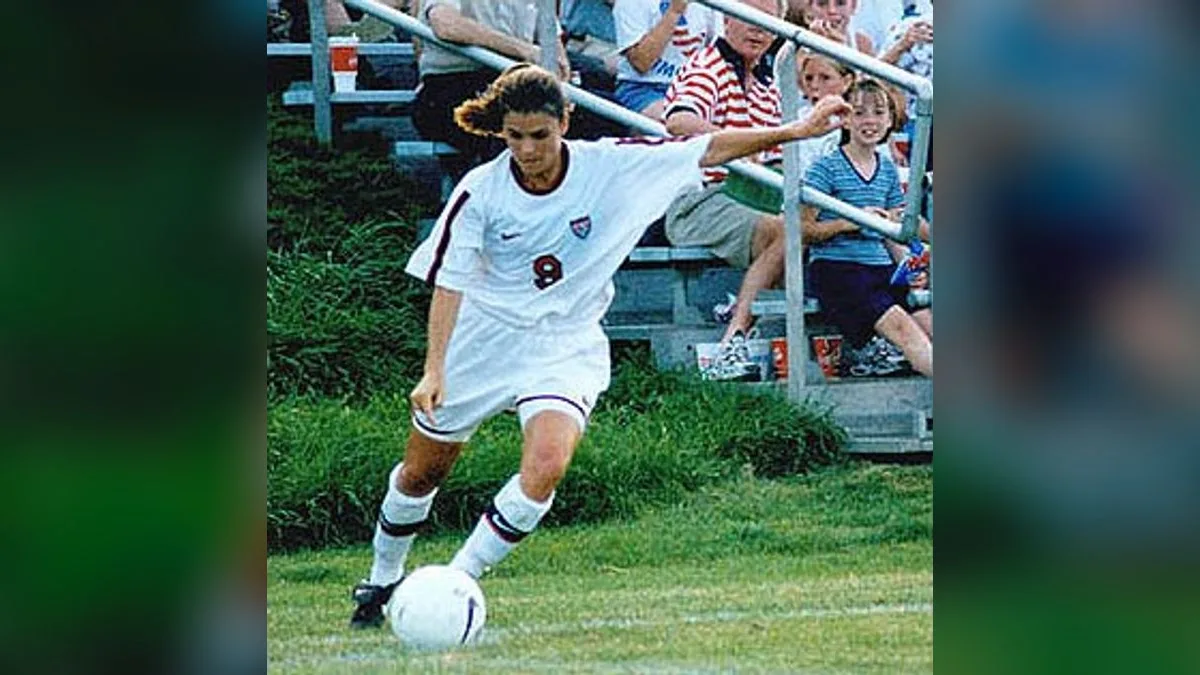
Mia Hamm is the American forward who made women’s soccer feel inevitable. Her rise tracked the sport’s growth, from a small circle of pioneers to sold‑out stadiums and prime‑time finals. She scored, she created, and she carried a spotlight that changed what was possible for athletes who followed.
| Born | 17 March 1972 |
|---|---|
| Nationality | United States |
| Position | Forward |
| Height | 1.65 m |
| National team | United States (1987–2004) — 275 caps, 158 goals |
Roots and a fast rise
Hamm was born in Alabama in 1972 and grew up in a military family that moved often. The constant change did not slow her development. It broadened it. She played with and against boys, learned to adapt, and learned to love the ball. As a teenager she joined the United States national team. The call came early, and she stayed for a very long time. That early debut set the tone: fearless, fast, ready.
College soccer gave her a platform and a standard. At North Carolina, under a coach who demanded tempo and relentlessness, she won titles and sharpened habits that would define her career. Pressing without pause. Running behind. Receiving on the half‑turn. The college game could not contain her, but it prepared her for the pace and pressure of the international stage.
World stage: defining tournaments
Hamm’s first World Cup title came in 1991, when the tournament was young and attention was thin. She was part of a forward line that played at speed and cut teams apart. By 1995 the United States had a reputation as contenders every time they took the field, and Hamm had become a focal point for scouting reports worldwide.
The high‑water mark of profile and pressure came in 1999 on home soil. The United States lifted the trophy in front of massive crowds, cementing the team as a national story. Hamm’s blend of incision and poise fit the moment. Defenders tracked her runs and opened space for team‑mates; when the gap appeared, she drove into it. Her role was more than goals. It was gravity. The attack bent around her and through her.
At the Olympics she collected medals across three Games, including the first women’s football gold in 1996 and another at the end of her international career. Between those bookends she helped set the standard for how the United States expected to compete: front foot, aggressive, and unafraid of the ball.
Club career and the first pro era
Hamm’s club story sits at the start of professional soccer for women in the United States. After college, options were limited. Exhibition tours and national team camps filled the calendar. That changed with the launch of the first fully professional league, which placed her at the heart of an ambitious project. She joined Washington Freedom and became its face as the league tried to convert the energy of 1999 into a sustainable model.
In Washington she drew crowds and carried a heavy creative load. The team leaned on her movement and service as much as her finishing. The league’s initial run was brief, but it established a template for the professional structures that followed. Hamm’s club years showed both the challenge and the promise of a domestic league built around national team stars. The later success of professional leagues in the country traces a line back to that first attempt and to players who gave it credibility.
What made her special on the pitch
Hamm was a forward who read space faster than defenders could close it. Her first touch set her next action. She could separate with a quick burst or a change of angle, and she could disguise the final ball until the last instant. Many remember the goals. The passing mattered just as much. Wingers and centre‑forwards fed off her timing. Midfielders trusted her to hold width or tuck in and link.
In transition she was ruthless. A loose touch or a turnover invited a direct run at the back line. She did not overplay. Two touches, three at most, and the ball moved again with purpose. In settled play she drifted into half‑spaces, asked for the return pass, and combined with one‑touch layoffs that shifted defences out of shape.
Her technique was clean rather than flashy. Finishes were guided rather than blasted. She struck through the ball, opened her body for far‑post passes into the net, and bent crosses away from keepers for late runs. She was a reliable penalty taker and a calm presence in tight matches. Fitness and durability underpinned it all. Big tournaments reward players who repeat the same hard runs in the 90th minute. Hamm did that.
Records, milestones and the arc of influence
By the time she retired from international football, Hamm had scored more goals for her country than any player in history to that point. The total stood as the world record until the next generation pushed it higher. She also sat near the top of the assist charts throughout her career, which explains as much about her game as the scoring does. Team‑mates prospered alongside her because she created as many chances as she finished.
Numbers tell only part of her impact. Hamm helped move women’s soccer into the mainstream of American sports culture. She anchored national advertising campaigns, sold jerseys beyond traditional soccer markets, and became a first‑name athlete in a crowded landscape. That level of recognition for a women’s team player was new. It did not happen by accident. It came from sustained excellence, consistency at major tournaments, and a public presence that sponsors could understand.
Her generation built a clear identity for the United States: demanding, competitive, and used to winning. That identity influenced how youth coaches trained players and how colleges recruited. It also helped convince broadcasters and federations that investment could yield audiences. The crowds that greeted later World Cups and professional seasons did not appear out of nowhere. They were taught how to care by teams Hamm led.
Why she matters now
Legacy in football can be tactical, cultural, or structural. Hamm’s reaches into all three. Tactically, her blend of speed, movement, and final ball set the template for American forwards who do more than finish. Cultural influence is clear: she made it normal for a girl to dream of a soccer career and expect to watch women at the highest level on television. Structurally, her role in launching a professional league, even one that did not last, pushed the sport closer to a sustainable future.
Her post‑playing work has continued that arc, with efforts in philanthropy and in supporting the game’s growth. The details change over time, but the through line remains. Mia Hamm turned visibility into momentum. She set standards that still guide the United States in selection, preparation, and expectation.
For a generation of American fans, the first hero wore number 9. For players who followed, the path looked clearer because Hamm had already walked it, sprinted it, and strengthened it under pressure. That is why her story endures and why her influence shows up in every full stadium and every decisive, composed finish from a new forward taking her chance.
Frequently asked questions
What made Mia Hamm one of the greatest forwards in women’s soccer?
She combined sharp movement, quick decision‑making, and a clean technical game that let her find space and finish with composure. Beyond scoring, she created chances for teammates and repeatedly made the hard runs that matter in big matches.
What was Mia Hamm’s role in the early professional era of women’s soccer in the United States?
After college she became a central figure as the country’s first fully professional league launched, joining Washington Freedom and serving as the team’s public face. Her presence helped draw crowds and gave credibility to the experiment, laying groundwork for later, more stable professional structures.
How did Mia Hamm influence the culture and legacy of women’s soccer?
She helped bring the sport into mainstream American consciousness by combining on‑field excellence with a recognizable public profile that sold jerseys and attracted sponsors. Her standards for selection, preparation, and playing style shaped coaching and player expectations, and her post‑playing work continued to support the game’s growth.
