
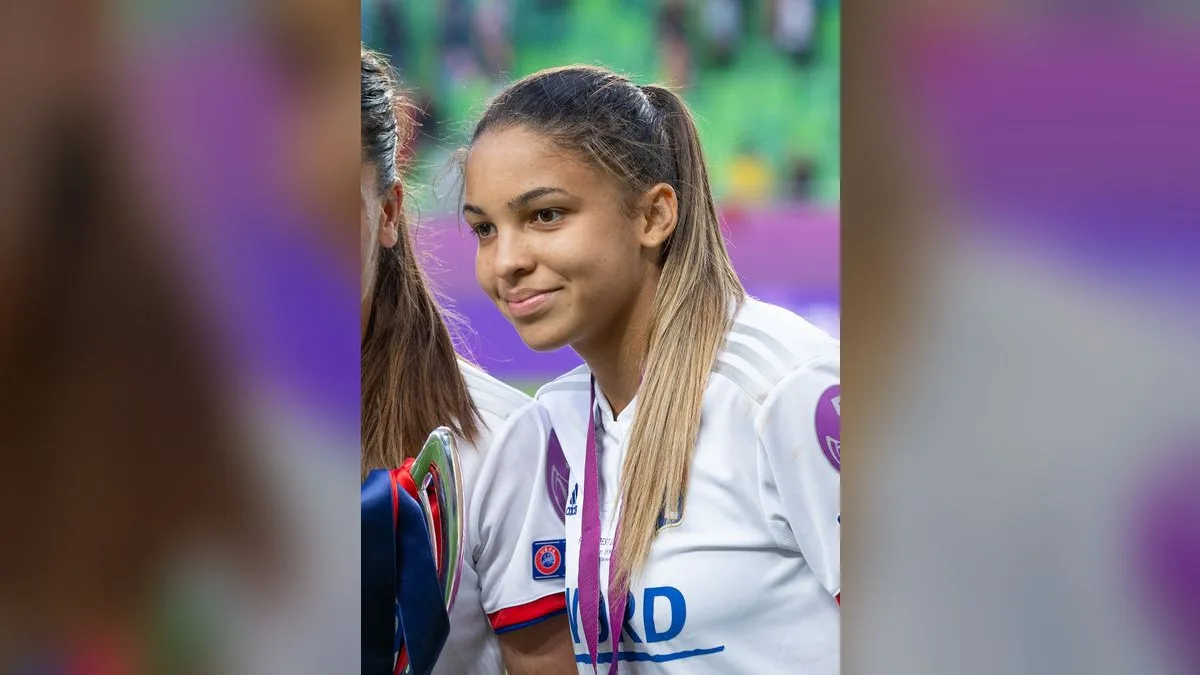
Delphine Cascarino arrived in senior football already marked out by one clear attribute: exceptional pace. That speed is the headline, but it sits on a broader technical platform. Her game is built around quick feet, tight ball control at high velocity and an instinct for the right pass in the final third. Those traits have kept her relevant as tactical demands of the wing role have shifted toward inside-forwards who can both create and finish.
| Born | 5 February 1997 |
|---|---|
| Nationality | France |
| Position | Midfielder |
| Height | 1.64 m |
Early development and pathway into senior football
Cascarino came through the structured youth environment that increasingly supplies France with forwards who are comfortable on either flank. From her first organised coaching sessions to the moment she stepped into adult competition she was notable for improvisational dribbling and an ability to accelerate sharply over short distances. Coaches at youth level shaped those raw gifts by encouraging her to play in tight spaces, to combine quick exchanges and to time her runs so that she could arrive ahead of defenders rather than chase them.
That early emphasis on technique as well as speed helps explain why she has been used in a variety of attacking roles. Even when listed as a midfielder, she frequently operates high and wide, or as a narrow, drifting wide attacker who links up with overlapping full-backs. Her background in youth setups also left her with a strong sense of team shape and pressing responsibility, which made the step into senior football less about raw physical adjustment and more about tactical nuance.
Breaking through and establishing herself
The move from promising youngster to established senior player came when she began to receive regular minutes against seasoned defenders. Her first sustained run in senior football exposed her to the defensive intelligence of opponents and forced her to refine decision-making under pressure. Rather than rely solely on acceleration, she learnt to disguise runs, to use feints and body orientation to carve space, and to pick passes that freed team-mates.
That process of refinement has been gradual and visible. Early senior appearances showcased moments of raw brilliance; later seasons revealed a more complete player who knows when to take the ball through or when to lay it off to a supporting attacker. Her ability to do both — commit defenders with direct play and then serve a decisive pass — is what turned sporadic promise into consistent selection.
International contribution
At international level she has been valued for the same combination of pace and technical subtlety that made her a domestic asset. Managers have used her as a way to stretch defences and to create mismatches against full-backs who are less comfortable defending in one-on-one situations. Her role has sometimes been as a specialist impact player, brought on to exploit tired opponents, and at other times as a starter tasked with opening games.
That tactical flexibility has made her useful across different systems. She can play as a touchline-hugging winger, a wide playmaker who drifts inside, or a forward who presses from the first line. In each role the emphasis is the same: quick transitions, forward momentum and the intelligent use of space. Her international experience has also sharpened defensive understanding: when a team asks its wingers to track back and form compact lines, she does not function only as an outlet but as a coordinated part of the shape.
What she does best on the pitch
Cascarino’s strengths are straightforward and complementary. First, her acceleration over short distances creates separation in tight attacking areas. Second, her dribbling at speed allows her to keep possession while moving into dangerous positions. Third, she times her runs and passes in the final third with an eye for teammates’ movement, producing chances that are difficult to defend because they arrive quickly.
These qualities combine to make her a dual threat: she can finish after cutting inside or craft opportunities from the wing. Opponents therefore cannot leave her unchecked, and that attention often creates space for team-mates. Coaches who need a player to change the pace of an attack or to destabilise a compact defence find her profile useful.
Why she matters to the game
Her importance is partly tactical and partly symbolic. Tactically, she embodies the modern winger: not just a touchline sprinter but a technical operator who can interchange, press and contribute to build-up play. Symbolically, players with her blend of speed and skill highlight how women’s football now prizes explosive athleticism married to precise technique. She represents a template for developing attackers who can adapt to multiple systems and remain dangerous.
Beyond the pitch, her rise from youth setups to sustained senior involvement is a reminder of the value of coherent development pathways. Young players who show raw speed are being coached to add technique and decision-making, which lifts the overall standard of attacking play. That broader effect — a generation of wide attackers who can both create and finish — is one reason why she matters to the sport’s evolution.
Career highlights and roles
- Explosive pace: A weapon in transition that opens defences by beating markers over short runs.
- Close control: Maintains possession while accelerating, which allows her to dribble into shooting positions.
- Versatility: Deployable wide, inside, or as a pressing forward, giving coaches tactical options.
- Game-changing impact: Used both as a starter and as an impact substitute to alter tempo and attack shape.
Her career so far reads as the arc of a specialist who broadened her game. The raw attribute — speed — brought attention. Technique and tactical intelligence converted attention into sustained influence. That combination makes her one of the quicker, more useful attacking players available to French selectors and to top-level teams.
Frequently asked questions
What position does Delphine Cascarino play?
Delphine Cascarino is primarily deployed as a wide midfielder or winger who can also operate as an inside forward. Her role varies by coach, but she is generally used to provide pace, dribbling and attacking thrust from wide areas.
What are Delphine Cascarino’s main strengths?
Her principal strengths are explosive short-distance acceleration, tight control while running at high speed, and an instinct for the final pass. These attributes let her beat defenders one-on-one and create quick chances for team-mates.
How does Cascarino fit into the national team?
She has been used both as a starter and as an impact substitute, depending on tactical needs. Managers value her ability to stretch defences in transition and to offer a direct attacking option from wide positions.
