
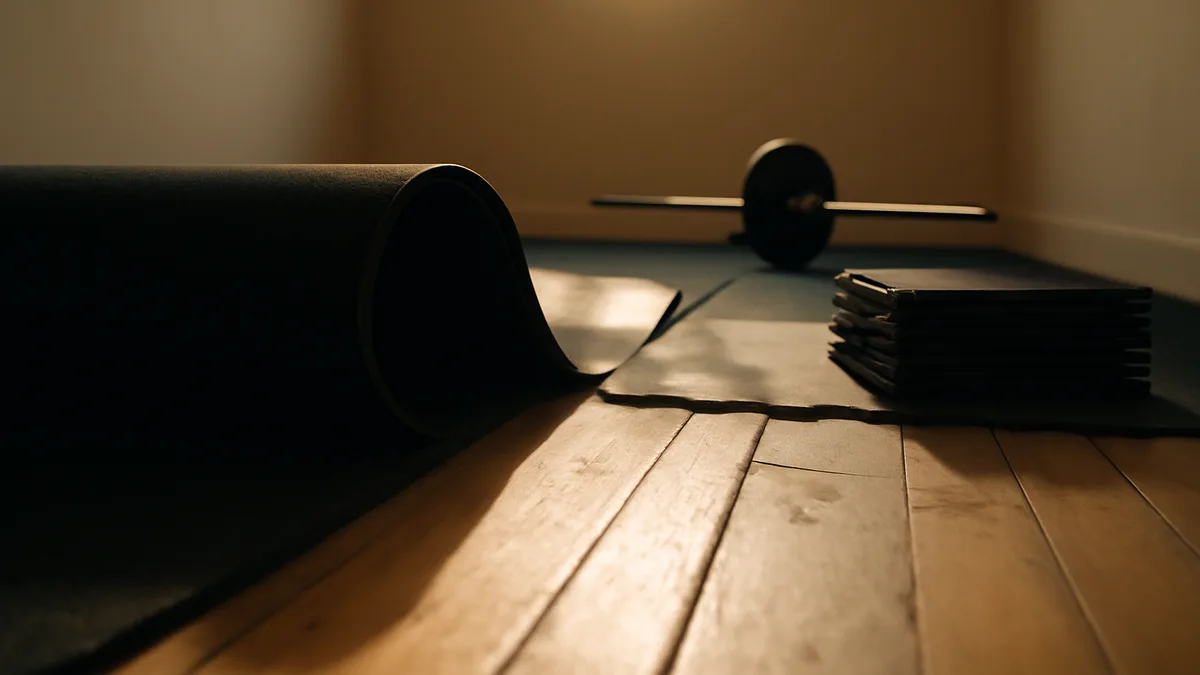
Choosing flooring for a home gym turns on three things: how much drop protection is needed, what the building subfloor will tolerate, and how much noise can be shared with neighbours. Decisions about tiles versus rolls, foam versus rubber, and edge detailing follow from those priorities.
This guide gives an ordered checklist of the main technical choices, explains common mistakes and shows how priorities differ for a beginner and for an experienced lifter or coach. A short comparison table helps match a product type to a clear set of needs.
How to decide
Start by listing the activities the room will host and the limits set by the building. Strength training with dropped weights, Olympic lifts, heavy kettlebells, cardio machines and yoga all place different demands on the floor. If the landlord or building rules restrict adhesives or permanent changes, that constraint should shape the material choice before anything else.
Most people get wrong
The two biggest mistakes are underestimating thickness for dropped weights and ignoring impact to neighbours below. Buyers often pick a cheaper thin roll because it looks adequate when standing, but it won’t protect a subfloor from barbell drops. Conversely, over-specifying an extremely heavy mat for a flat can make installation and future removal impractical.
Beginners versus experienced users
Beginners typically value comfort, cost and ease of install. A dense foam or thin rubber tile works well for bodyweight work, mobility and light weights. Experienced lifters and semi-pro coaches must prioritise high-impact protection, a durable wearing surface and load distribution so that dropped weights don’t damage joists or disturb neighbours.
Flooring types compared
| Type | Impact protection | Noise control | Ease of install |
|---|---|---|---|
| Interlocking rubber tiles | High — engineered for dropped weights | Good — dense rubber reduces transmitted shock | Moderate — simple to lay, removable |
| Rubber rolls | Moderate to high — depends on thickness | Good — continuous layer reduces flanking noise | Challenging — heavy and needs trimming |
| Foam tiles or mats | Low to moderate — comfortable but compressible | Poor — transmits impact noise beneath | Easy — light and quick to install |
| Wood or laminate with underlay | Low — needs sacrificial platform for drops | Variable — underlay helps airborne noise but not impact | Moderate — requires fixing and finish |
Impact thickness and composition
Choose thickness to match the heaviest dropped load expected and the stiffness of the subfloor. Solid rubber and bonded-rubber tiles provide far better shock attenuation per millimetre than simple EVA foam. For serious dropping, use a multi-layer solution: a thicker shock-absorbing base with a wear layer on top rather than one soft sheet alone.
Tiles versus rolls
Interlocking tiles give local repairability and a neat perimeter without seams, while rolls make a continuous surface that resists moisture and is slightly better for noise control. Tiles are easier for a DIY installer to handle alone; rolls often require two people to lay without wrinkles and need accurate trimming at edges.
Surface wear layer and traction
The top surface must balance grip for dynamic movement with durability for repeated machine or sled use. Vulcanised rubber and bonded layers resist abrasion from shoes and equipment better than uncoated crumb rubber or plain foam. For sleds or heavy trolleys, a textured wear layer will resist displacement and scuffing.
Edge, threshold and perimeter detailing
How the flooring meets doorways, skirting and adjacent rooms matters for trip risk and moisture control. Use tapered ramps or commercial-grade edge strips where a gym floor meets a corridor; avoid leaving thin cut edges exposed, which can curl and wear quickly. Where a removable floor is required, design a border that hides seams without adhesives.
Subfloor condition and load distribution
Assess the subfloor for creaks, deflection and joist spacing before choosing a surface. A stiff plywood underlay or a purpose-built platform spreads point loads and reduces the chance of structural damage beneath. If the existing subfloor is soft or has noticeable bounce, add a load-spreading layer rather than relying solely on a soft top mat.
Noise and vibration in flats
Noise control is an independent design choice: some floors reduce airborne sound, others reduce impact transfer. Dense rubber tiles and decoupled underlays reduce impact transmission better than foam; adding mass and an isolation layer between the gym floor and the joists helps most. If neighbours are a concern, plan for both a thick impact layer and an isolation strategy rather than assuming a single mat will suffice.
Cleaning, maintenance and longevity
Consider how frequently equipment will move and what fluids might spill. Rubber surfaces resist oils and are easy to hose or mop, while foam can trap sweat and degrade with chemical cleaners. Durability choices should be driven by usage patterns: fixed machines and heavy free weights call for materials rated for abrasion and tearing, not just initial comfort.
Common checklist (a quick decision list)
- Primary activity: Name the dominant use and choose impact rating accordingly, with dropping strength needing the highest protection.
- Noise limit: Decide acceptable impact transfer to neighbours and select a dense rubber or isolation layer if limits are low.
- Subfloor tolerance: Check whether the subfloor can take adhesives or screwed fixing and plan underlay or floating installation to suit.
- Portability: Pick tiles for removability and rolls for seamless coverage if permanence is intended.
- Wear resistance: Choose a textured or bonded wear layer where machine feet or heavy traffic will rub repeatedly.
What to do next
Measure the room and list the heaviest loads and equipment footprints. Test-fit a small sample tile or roll to check the feel and the interaction with the subfloor. Where neighbours or a landlord set limits, take a photo of the proposed area and the subfloor details to discuss with them before a full purchase.
The phrase subfloor appears in the guide because assessing the existing base is central to any sensible purchase. For a deeper technical background on construction layers and underlays, consult standard building guidance on foundation and floor assemblies.
Frequently asked questions
What thickness for dropped weights?
Thickness should match the heaviest load expected and the subfloor stiffness. Serious barbell drops need multi-layer protection: a dense impact layer combined with a wear surface or a dedicated platform rather than a single thin mat.
Are tiles better than rolls in flats?
Tiles are easier to install, remove and repair, which suits rented flats, while rolls give a continuous surface that helps noise control. For flats where impact noise matters, choose dense rubber tiles with an isolation layer or a rolled rubber with an appropriate underlay.
Do I need an underlay or platform?
If the subfloor is flexible, an underlay or a plywood platform spreads loads and reduces bounce and point pressure. An isolation layer between the gym surface and the joists also reduces impact transmission to rooms below.
