
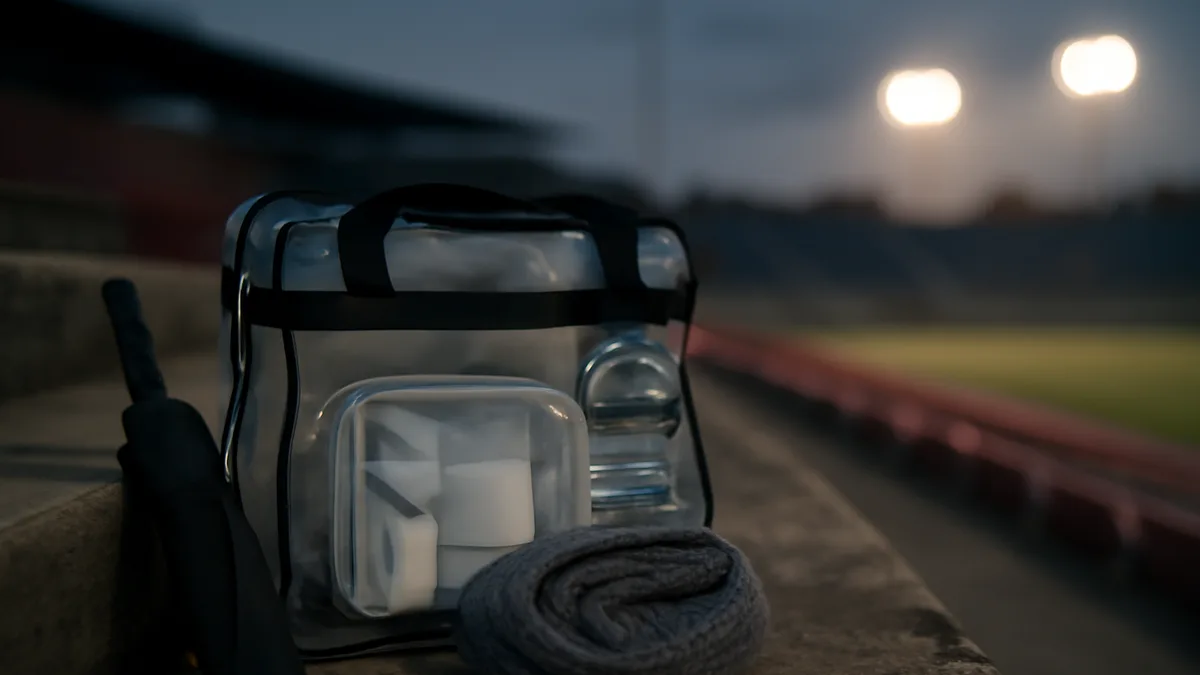
Choosing a bag for a match is a small decision that often determines how quickly fans pass security, whether possessions stay safe and if anything has to be left behind at the gate. The two factors that matter most are the venue’s bag policy and what the matchday requires: food, layers, camera kit or medical supplies.
This guide lists the priorities in the order they matter at most stadia, explains where supporters typically go wrong, and offers quick practical fixes for items that are not allowed inside.
How to decide what to bring
Start with the venue’s published rules and the event type. A domestic league match, an away European tie and a music concert at the same ground can all have different restrictions. If the venue publishes clear-bag rules, those are the baseline; if not, expect security to apply a standard, safety-first approach and prepare accordingly.
Where people go wrong
Fans commonly misjudge three things: the permitted bag size and transparency, the acceptability of folding umbrellas and the presence of specialist medical items. Assuming a small rucksack will pass is riskier than packing a clear bag, while relying on security to store valuables rarely works smoothly on busy matchdays.
List: priority checks for stadium bags and items
Spectator rules first
Always check the venue’s official bag policy before leaving. The club or stadium publishes permitted bag sizes and any clear-bag requirements, and that single check rules out most problems at entry.
Clear-bag and transparency
If a venue enforces clear-bag rules, only transparent or Mesh bags that meet the stated dimensions are allowed through; opaque backpacks and large holdalls will be refused. Clear bags speed searches and are the simplest way to carry small essentials when venues require visibility.
Size and capacity
Smaller bags pass checks faster and are less likely to be refused; prioritise a compact option that still holds essentials. For those needing extra capacity, choose a bag with external pockets that remain visible to security, keeping high-volume items to a minimum.
Liquids and food
Most stadiums restrict large containers and outside alcohol; single small bottles of water are more commonly permitted but always check the specific venue. If food is necessary for medical reasons, carry documentation and put it in an obvious pocket to speed inspection.
Electronics and cameras
Small personal devices like phones and compact cameras are usually allowed, while professional camera bodies with interchangeable lenses, tripods and large audio recorders are often prohibited. Treat any item that could be used to record or obstruct the view as potentially restricted and pack it where security can see it clearly.
Umbrellas, flags and poles
Compact, foldable umbrellas without sharp points are sometimes permitted but long-handled umbrellas and poles for flags are typically banned for safety reasons. If a flag uses a rigid pole, plan to leave the pole outside and bring only the fabric if permitted.
Prohibited items and weapons
Anything that could be used as a weapon, including blunt objects, fireworks, flares and glassware, will be refused and can lead to ejection or legal consequences. When in doubt, assume it is prohibited and remove it from matchday kit before arriving at the stadium.
Medical items and prescriptions
Essential medical equipment is usually allowed, but bringing a letter or prescription speeds entry and avoids confiscation. Keep medical items in an external pocket and inform security at the point of entry to reduce delays.
Valuables and storage options
Do not rely on stadium cloakrooms to store valuables unless the venue explicitly offers a secure service; many provide only temporary, unsupervised storage or none at all. Prefer carrying valuables on the person in a small inner pocket or leave them locked in a car or at a secure storage facility near the ground.
Table: comparing common bag types
| Bag type | Visibility at security | Typical capacity | Usability under clear-bag rules |
|---|---|---|---|
| Small crossbody | Low | Low | Often disallowed unless transparent |
| Clear tote or pouch | High | Low to medium | Designed to comply with clear-bag rules |
| Mesh drawstring bag | High | Medium | Accepted at many venues but check size |
| Regular backpack | Low | High | Often refused or inspected thoroughly |
What differs for a beginner and for someone experienced
Beginners should pack only essentials and prefer clear or mesh bags to avoid delays. Experienced matchgoers know busy entry points, bring minimal valuables and carry necessary documentation for medical items to speed inspections.
Experienced supporters also layer smartly: they wear pockets for passports and tickets and place cameras or larger items in transparent carry cases. They arrive early to avoid queues, which reduces the chance that guarded storage is full and forces hurried decisions outside the turnstiles.
What to do if an item is refused
If security refuses an item, options depend on the venue. Common solutions are returning the item to a vehicle, leaving it at a nearby staffed left-luggage facility, or entrusting it to someone not entering the ground. If none of those exist, the most reliable fallback is to plan ahead and not bring the item at all.
What to do next
Before the next match, read the club’s bag policy and check for any special event notices. Pack essentials in a clear or mesh bag where possible, keep medical documentation handy and plan a safe place for valuables that will not be taken into the stadium. Those steps remove most matchday friction and mean the trip will be about the match, not the queue.
The following sentence links to guidance on venue security and inspection practices: stadium security.
Frequently asked questions
Are clear bags always required
Clear bags are required at some venues but not all; the requirement is set by each stadium or event organiser. Check the ground’s published policy before travelling because local rules vary and change for special events.
Where should I leave prohibited items
Common options are a parked vehicle, an official left-luggage facility near the ground or giving them to a non-attending companion. If none are available, avoid bringing items likely to be refused.
What proof for medical items is accepted
A prescription or a signed note from a clinician is widely accepted and speeds inspection, but policies differ by venue. Keep documentation visible and notify security on arrival to reduce the chance of confiscation.
