
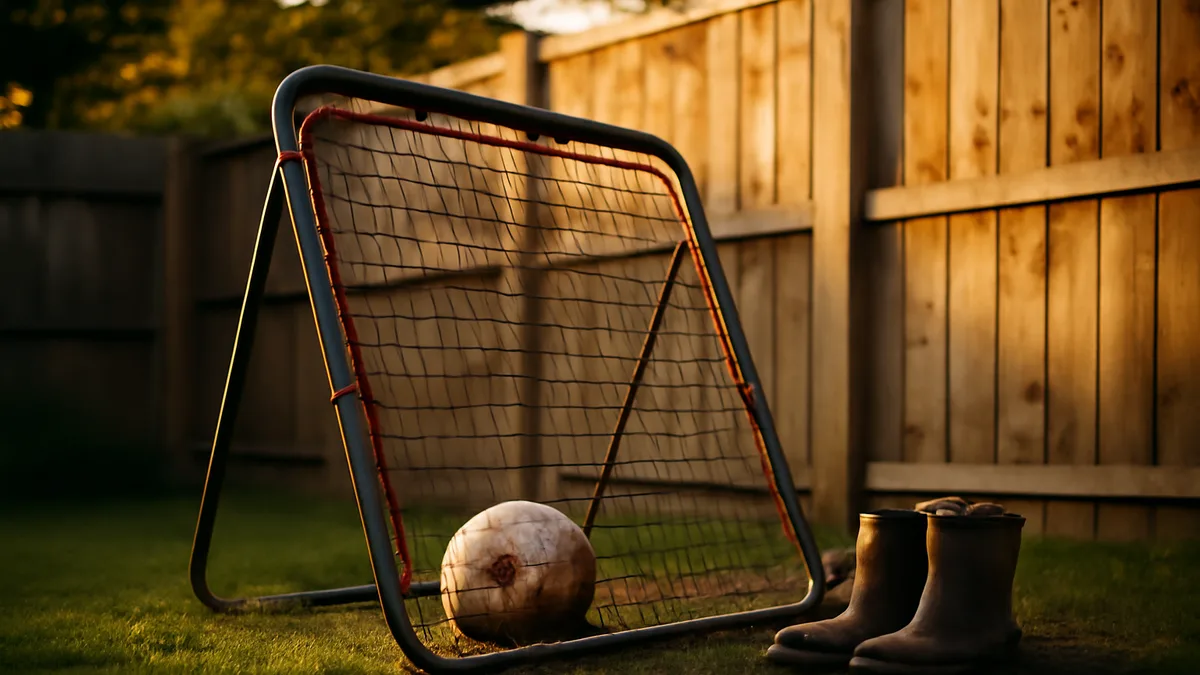
Choosing a rebounder or solo net turns on three things: the space available, the practice goals, and how much force the device must absorb. Different designs change the rebound angle, the speed of the return and the risk to nearby fences or neighbours.
This guide lists the priority checks in the order they matter for most players, then explains where people commonly go wrong and what differs for beginners and experienced players. There is a short comparison table and a checklist to take when buying or testing a unit in person.
How to decide before shopping
Decide what is being practised and where it will live. If the aim is passing and first-touch work a softer, slower rebound is often better; finishing practice needs a faster, truer return. Measure the location: full driveways, small lawns and balconies each rule out different formats.
Also consider surroundings. A concrete drive will increase ball speed on a miss; a fence or shed a few metres away can be damaged by high-power shots or by a heavy frame that falls. Think about storage and how often the unit will be set up — a permanently anchored, heavy rebounder suits a backyard used daily, while a pop-up net is better for occasional sessions and easy storage.
Priority checks in order
Frame strength and anchors
Frame strength is the first safety and durability decision. Tubular steel or thick alloy frames resist bending under high force and, when combined with good ground anchors or weighted bases, stop the unit toppling into fences or garden features.
Net or surface type
The return surface determines rebound character. Taut knitted nets produce a sharp, fast return; woven mesh or fabric panels give a slower, softer return. Some panels are designed to absorb energy and reduce ricochet, which matters when a fence or neighbour is nearby.
Angle and adjustability
Angle controls direction and useful drill variety. Fixed angled rebounders give a reliable trajectory for specific drills; adjustable units allow the same frame to be used for passing, volley practice and low-driven shots. If space is limited, choose an angle that directs returns away from fragile boundaries.
Sizing and footprint
Size must match the training goal and the available space. Larger frames create more realistic finishing practice and tolerate off-centre hits; smaller targets force accuracy work and are usually easier to store. Always allow clearance behind the unit for anchoring and for the ball to come back safely.
Portability and storage
How often the unit moves should shape the construction. Hinged frames and pop-up nets prioritise portability and quick set-up, while welded frames prioritise stability and longevity. Consider the weight and whether it can be lifted by the people who will move it.
Ground surface compatibility
Surface compatibility affects anchors and wear. Metal spikes grip turf but are useless on concrete; flat feet and weighted bases work better on hard surfaces. Rebounders used on artificial turf need protection under contact points to avoid tearing the carpet.
Return speed and rebound predictability
Return speed determines which drills are practical. Elastic cords and springs tend to give a livelier, quicker rebound ideal for reaction training; mat or panel surfaces give a predictable, slower return better for technique work. Prioritise predictability for solo skill repetition, and speed for reactive drills.
Fence and property risk
Choose a design that minimises risk to boundaries. A quick test: stand where the unit will sit and kick at different angles; if any miss would direct the ball toward a fence, choose a unit whose frame or angle channels returns inward or use a sacrificial backstop. Avoid heavy frames that could damage a fence if they fall.
Common mistakes people make
Buyers often pick by headline size rather than usable footprint, ending up with a unit that cannot be properly anchored. Another frequent error is buying a very lively rebounder for a small garden; the stronger returns increase the risk of balls clearing fences. Finally, neglecting storage leads to equipment left outside in winter, which shortens the life of nets and elastics.
Beginners versus experienced players
Beginners benefit from softer, more predictable returns and smaller targets that force accurate passing rather than power. Experienced players often want a firmer, faster return and adjustable angles for varied shooting and reaction drills. Clubs and coaches training high-level players typically choose sturdier, permanently sited units that tolerate high-intensity work and frequent use.
A quick checklist to test before buying
- Try the rebound: Kick at the intended range and judge direction and speed from the player’s position.
- Inspect the frame: Look for welded joints, tube thickness and the presence of quality anchors or weighted options.
- Check netting: Examine attachment points and mesh density for wear resistance and ball control.
- Evaluate portability: Assess how easily the unit breaks down and who will move it.
- Consider surface: Confirm appropriate anchors or protection for the ground the unit will sit on.
Comparison of common types
| Rebound speed | Adjustability | Portability | Fence risk | |
|---|---|---|---|---|
| Angled framed rebounder | Fast | Often adjustable | Moderate | Moderate |
| Elastic cord/spring unit | Very fast | Limited | High | Higher |
| Panel or cloth mat | Slow to moderate | Usually fixed | High | Lower |
| Pop-up net or small goal | Variable | None | Very high | Low to moderate |
Brands and durable features to look for
Certain brands have lines known for particular traits: some makers are known for sturdy tubular frames that suit permanent backyard install, while others specialise in lightweight pop-up goals and compact nets that fold away. SKLZ-style training nets are widely recognised for predictable angled rebounds, Quickplay-style frames are associated with robust tubular construction, and pop-up lines such as PUGG are recognised for fast deployment and easy storage. Match the brand trait to the intended use rather than buying the most heavily marketed option.
What to do next
Measure the space and test a candidate in the same surface and position where it will be used. If possible, try several net types at full kicking power to check direction and speed. Secure appropriate anchors and, if a fence is nearby, add a sacrificial backstop or angle the unit so mis-kicks return to the centre of the garden.
Check The FA guidance on equipment and safety before installing a permanent frame and remember that FIFA recommendations on training surfaces apply to artificial turf when choosing anchors and ground protection.
Frequently asked questions
What size rebounder for a small garden?
Choose a compact unit with a smaller footprint and a slower return to keep balls in play. Ensure the frame can be staked or weighted securely on the surface available.
Will a rebounder damage my fence?
Damage risk comes from heavy frames toppling or repeated misses directing high-speed shots at timber. Reduce risk with proper anchoring, angled placement away from the fence or a sacrificial backstop.
Which net type suits skill training?
A taut knitted net or firm panel gives a predictable, quicker rebound for first-touch and passing drills, while a fabric or looser mesh softens the return for technique work. Choose predictability for repetition and liveliness for reaction sessions.
