
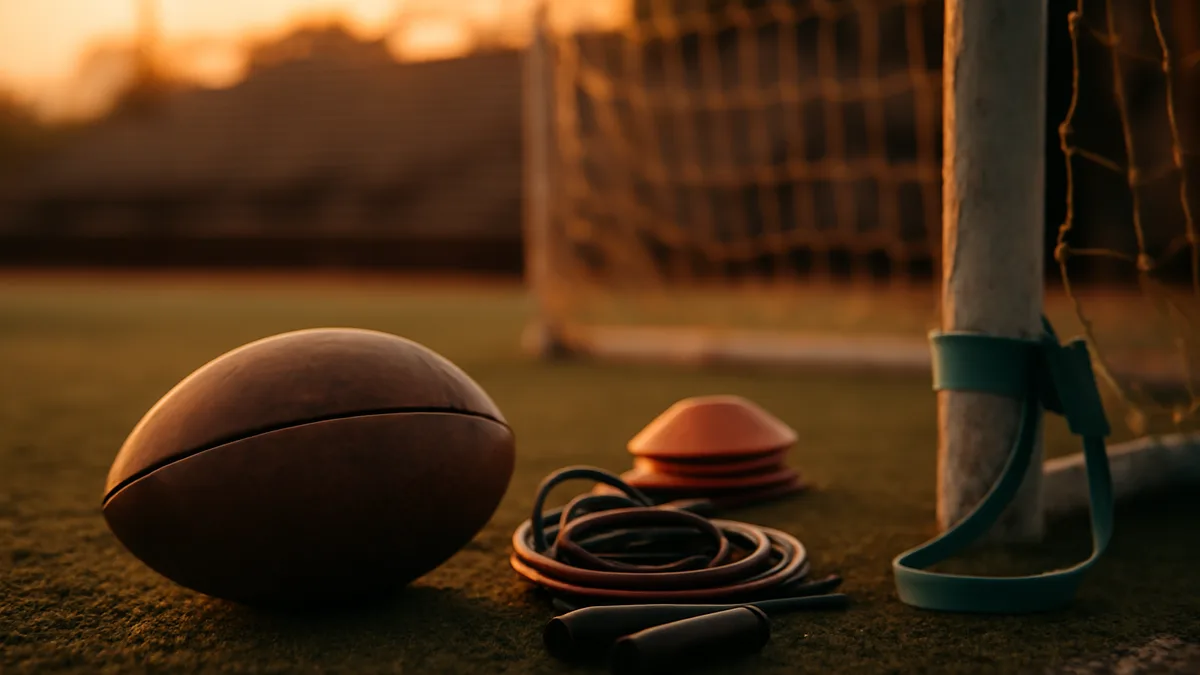
Choosing kit for home football training equipment turns on two clear trade-offs: space and versatility. Small homes demand compact items that do multiple jobs; limited money demands choices that raise training quality across fitness, ball work and recovery.
This guide sets a priority order for what to buy first, second and third, and explains why each item belongs there. It also covers common mistakes, how the plan shifts for beginners versus experienced players, and a short comparison table of real alternatives.
Priority list: what to buy first, second and third
- Resistance bands — Bands are the top purchase because they deliver strength and mobility work in a tiny footprint. They let a player load push, pull and lower-body exercises without heavy weights and are easy to anchor to a door or post for football-specific movements like resisted sprints or glute activation.
- Durable ball — A good ball comes second because ball contact and repetition are non-negotiable for technical development. Even a lower-cost ball that holds pressure and feels like a match ball for first touch and passing drills gives far more carryover than additional fitness gear alone.
- Cones and agility markers — Cones are cheap, pack flat and convert any small patch of ground into a drill area. Use them for control patterns, shuttle runs, small-sided games and speed change drills; they make every session measurable and repeatable.
- Jump rope — A skip rope is the most space-efficient cardio tool and trains coordination, foot speed and conditioning at low cost. It requires almost no storage and can be substituted for short running intervals when outdoor running is impractical.
- Adjustable single weight — If space and budget allow, add one adjustable weight (dumbbell or kettlebell style) rather than a set. One implement that can change load covers lunges, single-leg deadlifts and loaded carries, which are high-value strength moves for footballers.
- Foam roller or massage ball — Recovery gear keeps training consistent by reducing soreness and improving mobility. A foam roller and a couple of small massage balls pay back in fewer missed sessions and faster warm-ups.
- Portable rebounder or wall target — If the budget stretches, a small rebounder widens technical options, adding volleys, first-touch reactions and passing repetition that a solo player otherwise struggles to replicate.
How to decide: a simple test for every purchase
Run every prospective buy through three questions. First, does it expand more than one session type? Items that help both strength and football technique (for example, bands used for resisted sprints and glute strengthening) offer more value. Second, is it space-friendly? If an item needs permanent room that displaces living needs, cost rises dramatically. Third, how likely is it to be used weekly? An inexpensive item used five times a week is worth more than an expensive one used once.
Buy in tiers rather than pieces. Start with essentials (bands, ball, cones, rope) and only add a weight or rebounder after those basics are in regular rotation. This sequence mirrors how most training plans actually work: technical repetition and basic conditioning should be the backbone, with strength and recovery layered on.
Where people go wrong on a small budget
Common mistakes are easy to avoid. The biggest is buying many single-purpose items that compete for space and attention: a static bike, a bulky weight bench and a dozen branded accessories add cost but rarely increase training frequency. Another error is choosing the cheapest ball or bands without checking durability; replacement costs and frustration from poor equipment often cancel the initial saving.
People also underinvest in recovery and mobility. Skipping a foam roller to buy a second weight makes little sense if tight hips and sore calves limit how often a player can train. Finally, buying too many items before learning how to program them is another trap — quality programming with a few versatile tools beats owning every gadget that promises progress.
Comparison table: alternates and trade-offs
| Item | Space required | Versatility | Durability |
|---|---|---|---|
| Resistance bands | Very low | High — strength, sprint resistance, mobility | Medium — quality varies, check seams |
| Adjustable weight | Low to medium | Medium — strength, carries, explosive drills | High — metal implements last longer |
| Rebounder | Medium | High for technical work, low for strength | Medium — weather and use affect frame |
What changes for beginners and experienced players
Beginners gain most from repetition and simple conditioning. Their first buys should emphasise a durable ball, cones and a jump rope to build technique, balance and aerobic base. Bands and basic weights come next, focused on mastering bodyweight control and injury-preventive routines.
Experienced players need targeted loading and specificity. They should prioritise bands for eccentric and sprint-resisted work, an adjustable weight for potent single-leg strength exercises, and a rebounder or wall target to spend high-quality time on rapid-fire technical touches. Recovery kit becomes more important as training intensity rises.
Next steps: put the kit to use
After buying, commit to a simple routine that rotates the equipment across sessions: one technical session (ball, cones, rebounder if available), one conditioning session (rope, cones), and one strength/mobility session (bands, weight, roller). Track session type and duration for a month before purchasing anything else — that record shows true gaps, not perceived needs.
For further structured drills and progression ideas, check The FA resources and consult FIFA training materials for fundamentals that suit solo practice.
Frequently asked questions
What basic equipment should I buy first?
Start with resistance bands, a durable ball and cones. These three items together allow strength, technical repetition and structured drills without requiring much space or money.
Can I train football skills alone at home?
Yes. Use a ball, cones and either a rebounder or a wall target to simulate passing and first-touch drills. Complement with jump rope cardio and resistance bands to maintain fitness and power.
Is a single adjustable weight worth buying?
An adjustable weight is useful because one implement can cover many strength exercises that matter for football, such as lunges and single-leg deadlifts. Choose it only after basic technical and conditioning items are in regular use.
